Table of Contents
- What You’ll Need Before You Start
- Tools for Cleaning Garage Floors: What Works and What Doesn’t
- How to Clean Epoxy Garage Floors: The Step-by-Step Method
- How to Remove Oil Stains From Epoxy Garage Floor
- Epoxy Floor Maintenance Schedule: Daily, Weekly and Seasonal Care
- What to Avoid: Harsh Chemicals and Abrasive Pads
- Troubleshooting: Scratches, Dull Patches and Stubborn Residue
- Frequently Asked Questions
Last Updated: September 13, 2026
What You’ll Need Before You Start
A properly cured epoxy floor is one of the most forgiving surfaces in a garage, but it still rewards preparation. Gather your tools before you start, because a half-set-up clean is how floors end up with streaks and missed patches.
Here’s what belongs in your kit:
- Soft-bristled broom or a dust mop for dry debris
- Microfibre mop with a replaceable head
- Two buckets (one for solution, one for rinse water)
- pH-neutral cleaner or a mild dishwashing liquid
- Warm water
- Microfibre cloths for spot cleaning
- A plastic scraper for dried-on gunk
Skip anything abrasive. No steel wool, no scouring pads, no stiff-bristled deck brushes. Epoxy resists a lot, but it does not resist being scratched by grit you drag across it.
A microfibre mop head protects a coating that cost far more to install.
Never use a power washer above low pressure on epoxy (PubMed). High-pressure water forces its way into seams and edges, and that moisture sits under the coating and lifts it. This is one of the most common causes of peeling on otherwise sound floors.
Tools for Cleaning Garage Floors: What Works and What Doesn’t
The right tool for a coated garage floor is soft, absorbent, and easy to rinse. Anything that grinds grit into the surface will dull the finish over time.
A soft-bristled broom handles daily debris removal. A microfibre mop does the actual cleaning. For heavier jobs, a rotary floor machine with a soft pad can help on large commercial slabs, but it’s overkill for a home garage.
| Tool | Best For | Avoid If |
|---|---|---|
| Soft-bristled broom | Daily dust and grit | You need to lift oil |
| Microfibre mop | Weekly wet cleaning | The floor is heavily soiled |
| Plastic scraper | Dried spills, gum, tar | The mark is a surface scuff |
| Rotary floor machine | Large commercial slabs | You’re cleaning a home garage |
| Power washer | Never on epoxy | Always, at high pressure |
What most guides miss is that a degreaser does not need to be aggressive to work. A diluted solution left to dwell for a few minutes lifts most oil far better than scrubbing hard with a strong chemical.
Keep two mop heads in rotation. One goes on the floor while the other dries. A damp, stored mop head grows bacteria and leaves a smell that transfers to the floor, and it takes seconds to swap.
How to Clean Epoxy Garage Floors: The Step-by-Step Method
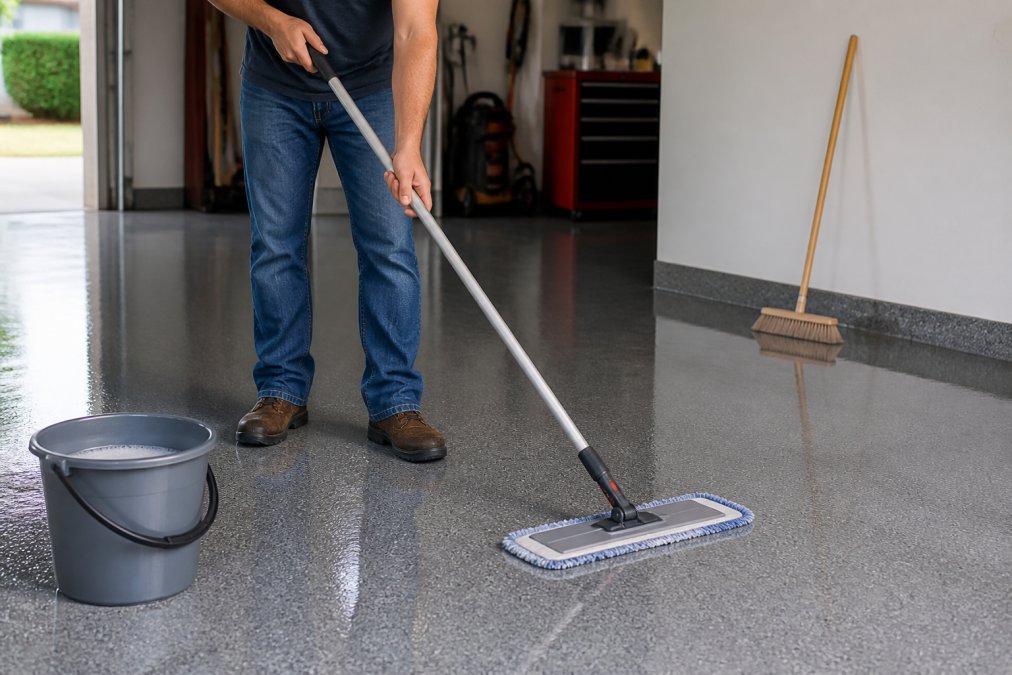
Cleaning a coated floor is a three-stage process: dry removal, spot treatment, then a full wet mop. Done in that order, it takes about 20 minutes for a standard double garage.
Step 1: Remove Debris and Loose Grit
Sweep or dust mop the entire slab first. Grit is the enemy here: if you mop over it, you drag abrasive particles across the coating and leave fine scratches that dull the finish.
Work from the back of the garage toward the door so you’re not walking over what you just swept.
Step 2: Spot Clean Stains and Marks
Deal with oil, grease, and scuff marks before wetting the whole floor. A diluted degreaser applied directly to the stain, left for a few minutes, then wiped with a microfibre cloth handles most of it.
For stubborn marks, a paste of baking soda and warm water works as a gentle abrasive that lifts residue without cutting into the coating.
Step 3: Mop With a Diluted Solution
Mix a pH-neutral cleaner with warm water in one bucket. Mop in sections, and rinse your mop head in the second bucket of clean water as you go. Change the rinse water when it turns grey.
Let the floor air dry, or run a squeegee to speed it up. Avoid walking on it until it’s fully dry, usually 15 to 30 minutes in a ventilated garage.
How to Remove Oil Stains From Epoxy Garage Floor
Oil is the one stain that needs patience rather than force. Epoxy is chemically resistant, so most oil sits on the surface rather than soaking in, which means a degreaser and time will lift it. The mistake is scrubbing hard, that drives the oil into micro-scratches and dulls the gloss without removing the mark.
The general method:
- Blot up as much fresh oil as possible with a paper towel or absorbent cloth before it spreads.
- Apply a diluted degreaser to the stain. Let it dwell for five to ten minutes.
- Wipe with a microfibre cloth, then rinse the area with clean water so no surface residue is left behind.
- Repeat once if the mark is old. If it survives two rounds, stop, see the troubleshooting section below.
Fresh Oil vs Old Oil
Fresh oil lifts easily with a single degreaser pass. Old oil that has baked on in summer heat, or that has been walked over for weeks, forms a tacky film that resists a single application. For old marks, apply the degreaser, cover the spot with a damp cloth to stop it drying out, and leave it for fifteen to twenty minutes before wiping. The dwell time does the work.
Other Fluids You Will Meet
- Transmission fluid and gear oil: thicker and more staining than engine oil. The same degreaser method works, but expect two or three passes and longer dwell times.
- Coolant: usually water-soluble, so a pH-neutral cleaner and warm water often lift it without a dedicated degreaser. Rinse well, because coolant residue can leave a sticky film.
- Brake fluid: treat this as a chemical spill rather than a stain. Wipe it up immediately and rinse the area thoroughly, because it is aggressive toward many coatings if left to dwell.
- Rust stains: these are mineral deposits rather than grease, so a degreaser will not touch them. A mild acidic cleaner formulated for coated floors is the usual approach; test on a hidden patch first.
- Paint and overspray: water-based paint wipes up while wet. Cured paint needs a plastic scraper used flat against the surface, working from the edge of the spot inward. Never use a metal blade.
- Tar and bitumen: soften first with a small amount of mineral spirits on a cloth, wipe, then wash the area with pH-neutral cleaner and rinse. Mineral spirits are a spot treatment, not a floor cleaner, use the minimum that does the job.
Tackling Tire Marks and Scuff Marks
Tire marks come off with a little more effort. A pH-neutral cleaner plus a microfibre cloth usually handles fresh marks. For older black rubber transfer, a small amount of baking soda on a damp cloth lifts it without harming the coating.
Scuff marks from shoes or tools respond to the same approach. Never reach for an abrasive pad: it removes the mark and the gloss in the same stroke.
Work stains from the outside in. Scrubbing the centre of an oil mark first spreads it outward and doubles the area you have to clean.
Epoxy Floor Maintenance Schedule: Daily, Weekly and Seasonal Care
A maintenance schedule is what separates a floor that looks new after five years from one that looks tired after two. The routine is light, but it needs to be consistent, and it needs to shift with the seasons, because what lands on a garage floor in July is nothing like what lands on it in July’s opposite month.
| Frequency | Task | Time |
|---|---|---|
| Daily | Sweep or dust mop loose grit | 2-3 minutes |
| Weekly | Microfibre mop with pH-neutral solution | 10-15 minutes |
| Monthly | Spot clean oil, tire marks, scuffs | As needed |
| Seasonally | Deep clean, inspect for scratches and dull patches | 30-45 minutes |
Winter: Salt, Slush and Grit
Road salt is the single most damaging thing most coated garage floors meet all year (PubMed). It is abrasive when dry, it holds moisture against the coating when wet, and the chloride it carries is aggressive toward the surface if left to sit. Slush carries the same load in a wetter package, and grit embedded in slush acts like sandpaper underfoot.
What works:
- Lay a coarse absorbent mat at the garage door threshold and shake it out weekly. Most of the salt load never reaches the slab.
- Rinse the floor with clean warm water after the worst weather passes, then mop as normal. A plain water rinse removes the salt residue that a pH-neutral cleaner alone can leave behind.
- Never let salty slush pool in low spots or along the door seal. Wipe or squeegee it out the same day.
- Watch the first metre inside the door most closely. That is where salt, grit and moisture concentrate.
Summer: Pollen, Dust and UV
In warmer months the problem flips from wet and corrosive to dry and abrasive. Pollen settles as a fine film that a dry broom pushes around rather than lifts, and fine dust from driveways and nearby construction grinds into the coating underfoot.
What works:
- Dust mop more often, not less. Dry grit is what scratches a gloss finish, and it builds up faster in dry weather.
- A damp microfibre mop lifts pollen far better than a dry sweep. Rinse the head often so you are not smearing it back down.
- If the garage faces direct sun for long stretches, be aware that UV exposure fades the colour and gloss of many coatings over years. Cleaning cannot reverse that, but keeping the surface free of abrasive dust slows the dulling.
Shoulder Seasons and Humid Spells
When the weather turns humid, condensation can form on a cool slab overnight. Wipe damp patches before they sit, and improve airflow by leaving the garage door cracked when it is safe to do so. In dry, dusty periods, dust mopping matters more because grit builds up faster.
If your garage doubles as a workshop, add a quick sweep after any job that produces dust or metal shavings. Those particles are the ones that do the most damage when they end up under a mop head.
What to Avoid: Harsh Chemicals and Abrasive Pads
The fastest way to ruin a good coating is to clean it with the wrong product. Epoxy is tough, but it has limits.
Avoid these:
- Ammonia-based cleaners, which dull the gloss over time (PubMed)
- Solvent-heavy degreasers, which can soften the coating
- Abrasive pads and steel wool, which scratch the surface
- Bleach at full strength, which can discolour the finish
- High-pressure washing, which forces water under edges
Stick to pH-neutral cleaners, warm water, and soft tools. If a spill is a harsh chemical, wipe it up promptly rather than letting it dwell, then rinse the area with clean water.
Troubleshooting: Scratches, Dull Patches and Stubborn Residue
Minor scratches from dragged tools or grit can often be buffed out during a normal clean with a soft pad and a little warm water. Deeper scratches that catch a fingernail need a touch-up rather than a clean.
Dull patches usually mean one of two things: surface residue from a cleaner that wasn’t rinsed, or fine scratching from abrasive cleaning. A rinse with clean water fixes the first. The second needs a professional assessment, because polishing a coating back to a high-gloss finish is a job for the right equipment.
Stubborn residue that won’t lift after two attempts is usually a sign the coating itself is worn in that spot, not that the cleaner is too weak. That’s worth a professional look before you scrub harder and make it worse.
If a mark survives two rounds of gentle cleaning, stop. Repeated scrubbing damages the coating, and a worn spot is a repair job, not a cleaning job.
A well-maintained epoxy floor should stay glossy and easy to clean for years, but cleaning can only protect a coating that was installed properly in the first place. If your floor is peeling, bubbling, or dulling faster than it should, the problem is usually underneath the surface. Garage Floor Coatings has spent over 20 years resurfacing concrete with epoxy, polyurethane, and flake systems built to resist wear, stains, chemicals, and moisture, with non-slip finishes that stay safe when wet. Our team handles everything from consultation to final finish, tailored to residential garages, workshops, and commercial spaces alike. Call now!
Frequently Asked Questions
What should I clean my epoxy garage floor with?
Use a pH-neutral cleaner diluted in warm water, applied with a microfibre mop. For everyday dust and grit, a soft-bristled broom or dust mop is enough. Avoid ammonia-based products, citrus degreasers and anything abrasive. A diluted solution of baking soda and warm water handles most surface residue without dulling the finish. Always rinse with clean water and allow proper dry time before walking on the surface.
What should you not clean epoxy floors with?
Skip harsh chemicals like bleach, ammonia, and solvent-based degreasers, as they break down the protective coating over time. Abrasive pads, steel wool and stiff brushes scratch the surface and reduce its high-gloss finish. A power washer used at high pressure can force water into seams and damage the coating. Stick to pH-neutral cleaners, soft cloths and microfibre mops to protect the floor’s slip resistance and appearance.
Is it okay to pressure wash an epoxy garage floor?
A power washer can be used on low pressure for heavy debris removal, but high-pressure settings risk damaging the protective coating, especially at edges and seams. If you do use one, keep the nozzle moving, stay at a shallow angle and avoid concentrating the spray on one spot. For most routine cleaning, a microfibre mop and diluted solution are safer and just as effective for maintaining the finish.
How often should I deep clean my epoxy garage floor?
A deep clean every three to six months works for most residential garages. Daily or weekly dust mopping and spot cleaning handle the in-between upkeep. Garages exposed to heavy oil spills, chemical use or seasonal grit may need deep cleaning more often. Following a consistent epoxy floor maintenance schedule, including seasonal checks and prompt stain treatment, extends floor longevity and keeps the surface looking sharp.