Last Updated: October 26, 2026
Quick Summary
Commercial epoxy floor finishes are engineered coatings that transform concrete into durable, protective surfaces built for constant foot and vehicle traffic. Epoxy creates a seamless, non-porous barrier that resists impact, abrasion, and staining while remaining easy to clean.
- High-build epoxy lasts 12-15 years versus 5-6 years for thin coatings, justifying higher upfront cost.
- Non-slip epoxy systems build texture into the resin itself and are easier to clean than aggregate finishes.
- Polyurethane topcoats reduce thermal marking risk under hot-tire contact better than epoxy alone.
- Slip resistance is measured by wet pendulum test, ramp test, and surface roughness methods, not a single number.
- Return to service varies from 24-48 hours for polyurethane to 5-7 days for high-build epoxy.
Table of Contents
- Why Commercial Epoxy Floor Finishes Matter in High-Traffic Spaces
- Understanding Commercial Epoxy Floor Coating Systems
- High-Build Epoxy: Maximum Durability for Warehouse Floors
- Polyurethane Floor Coating: Flexibility and Chemical Resistance
- Non-Slip Epoxy Flooring for Safety and Compliance
- Commercial Floor Maintenance: Protecting Your Investment
- Choosing the Right Finish for Your High-Traffic Environment
- Frequently Asked Questions
Why Commercial Epoxy Floor Finishes Matter in High-Traffic Spaces
Commercial epoxy floor finishes are engineered coatings that transform concrete into durable, protective surfaces built for constant foot and vehicle traffic. Epoxy creates a seamless, non-porous barrier that resists impact, abrasion, and staining while remaining easy to clean.
At Garage Floor Coatings, we have over 20 years of industry expertise. The right commercial epoxy floor coating protects your investment and keeps operations running.
High-traffic environments demand finishes that perform under pressure: a warehouse faces rolling loads, chemical exposure, and moisture; a commercial kitchen needs hygienic, seamless protection that meets food safety standards; a showroom needs visual impact that reflects your brand. The wrong finish can cost thousands in repairs or replacement.
Understanding Commercial Epoxy Floor Coating Systems
Commercial epoxy floor coating systems come in several formulations, each designed for specific performance demands. Learn more about epoxy resin floor options and specifications available for commercial applications. How they’re mixed, applied, and cured directly affects durability, flexibility, and ease of maintenance.
Epoxy consists of a resin and hardener that chemically bond into a rigid, protective layer. Mixed at the correct ratio and applied by experienced professionals, it forms a non-porous surface that prevents moisture penetration and chemical absorption, critical where concrete naturally absorbs liquids and degrades underneath.
Learn about epoxy resin floor options and specifications available for commercial applications | page:1
High-Build Epoxy: Maximum Durability for Warehouse Floors
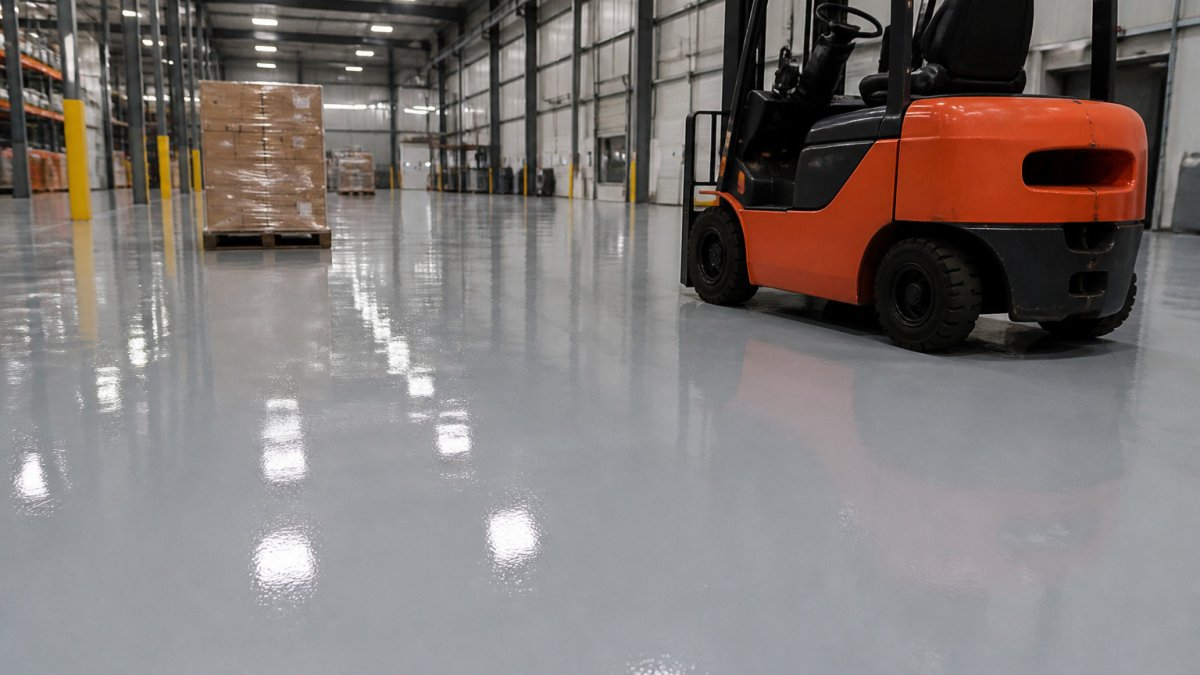
High-build epoxy costs more than standard systems, but the longevity justifies it for facilities that operate continuously. A warehouse replacing a thin coating every 5-6 years spends considerably more over time than one that applies high-build epoxy once and maintains it for 12-15 years.
Polyurethane Floor Coating: Flexibility and Chemical Resistance
Explore polyaspartic flooring as an alternative or complementary coating system for high-traffic areas | page:2
Non-Slip Epoxy Flooring for Safety and Compliance
Textured epoxy systems build slip resistance into the resin itself, creating a uniform texture without broadcast particles. They’re easier to clean than aggregate finishes and provide consistent protection, with a less pronounced texture suited to showrooms where aesthetics matter alongside safety.
How Slip Resistance Is Measured and Specified
Slip resistance is not a single number. It is measured by test methods that simulate different walking conditions, and the results are expressed in classifications that specifiers can write into a scope of work. The most commonly referenced methods are:
- Wet pendulum test, measures the coefficient of friction of a surface under wet conditions and is widely used for pedestrian areas.
- Ramp test, assesses slip resistance on an inclined surface and is often used to classify products for barefoot and shod areas.
- Surface roughness and micro-roughness measurements, used to verify that the applied texture matches the specified profile.
Australian Compliance Context
- Work health and safety legislation, each state and territory imposes a duty on persons conducting a business or undertaking to manage risks, including slip risks, so far as is reasonably practicable. A documented slip-resistance specification is part of demonstrating that duty.
- The National Construction Code (NCC), sets performance requirements for building elements, including floor surfaces in certain classifications and wet areas. The NCC references Australian Standards for verification.
- Australian Standards, AS 4586 covers slip resistance classification of new pedestrian surface materials, and AS 4663 covers the wet pendulum test method. Specifiers commonly cite these standards when writing flooring scopes.
- Safe Work Australia, publishes model work health and safety guidance that informs state and territory regulators’ expectations for managing slip hazards.
The Cleanability Trade-Off
Do not accept a slip rating printed on a product data sheet as proof of site compliance. Ask for the test report, confirm the method and classification, and verify that the installed system matches the tested specification.
Non-slip epoxy costs slightly more than standard smooth finishes, but the safety benefit and liability protection justify it wherever wet floors are common.
Commercial Floor Maintenance: Protecting Your Investment
Discover proper cleaning and sealing techniques to maintain epoxy floors long-term | page:3
Choosing the Right Finish for Your High-Traffic Environment
Selecting the right commercial epoxy floor finish requires understanding your environment, traffic patterns, and performance requirements. Contact us or view our services to get a consultation for your specific flooring needs. A one-size-fits-all approach will disappoint: the finish that works in a showroom may fail in a warehouse, and vice versa.
Start With the Traffic, Not the Product
| Traffic type | Dominant wear mechanism | Finish direction | Practical notes |
|---|---|---|---|
| Pedestrian foot traffic (retail, showroom, office) | Abrasion from grit and scuffing | Standard or decorative epoxy with a clear topcoat | Prioritise appearance and cleanability; lighter build is adequate |
| Pallet jacks and trolleys | Point loads and rolling abrasion | High-build epoxy or epoxy with a polyurethane topcoat | Check build thickness and impact resistance |
| Forklifts and heavy rolling loads | High point loads, impact, turning scrub | High-build epoxy, often with aggregate reinforcement | Confirm compressive strength and cure schedule before return to service |
| Vehicle turning and hot-tire contact | Shear stress and thermal marking | Polyurethane or polyaspartic topcoat over epoxy | Epoxy alone can mark under hot tires; a flexible topcoat reduces the risk |
| Heavy static machinery | Vibration and point loading | High-build epoxy with isolation details at anchor points | Consider movement joints and equipment pads |
| Wet or washdown processes | Moisture, cleaning chemicals, slip risk | Polyurethane or non-slip epoxy with documented slip rating | Balance texture against cleanability |
Compare Systems Against Measurable Criteria
| Criterion | Standard epoxy | High-build epoxy | Polyurethane topcoat | Poly-cement / cementitious urethane | Grind-and-seal |
|---|---|---|---|---|---|
| Abrasion resistance | Moderate | High | High | High | Low to moderate |
| Impact resistance | Moderate | High | Moderate to high | High | Low |
| Chemical resistance | Moderate | High | High | High | Low |
| Slip resistance (with texture) | Good | Good | Good | Good | Variable |
| UV stability | Poor (ambers) | Poor (ambers) | Good | Good | N/A |
| Moisture tolerance during application | Low | Low | Low | Higher | N/A |
| Typical return to service | 24-72 hours | 5-7 days | 24-48 hours | 24-72 hours | 24-48 hours |
| Relative installed cost | Low | High | Moderate to high | High | Low |
Lifecycle Cost and Total Cost of Ownership
- Installed cost, preparation, primer, build coats, topcoat, and any aggregate or coving.
- Maintenance cost, cleaning labour and consumables, which vary with texture and process.
- Recoating interval, the expected years before a refresh coat is needed.
- Repair cost, the cost and disruption of localised repairs after impact or chemical damage.
- Downtime cost, lost operating hours during installation and cure, which can exceed the coating cost in busy facilities.
Plan the Installation Around Downtime
At Garage Floor Coatings, we provide a seamless experience from initial consultation to the final finish. Our tailored flooring solutions serve residential, commercial, and industrial clients.
Frequently Asked Questions
How long does a commercial epoxy floor finish typically last in a high-traffic environment?
Commercial epoxy floor finishes designed for high-traffic areas generally last 5-10 years with proper maintenance, depending on the coating system and traffic intensity. High-build epoxy systems and polyurethane coatings tend to outlast standard epoxy in heavy-use warehouses and workshops. Factors affecting longevity include surface preparation quality, cure time before operation, regular cleaning, and prompt repair of any damage. Facilities that follow recommended maintenance schedules and avoid harsh chemicals incompatible with their coating system see the longest service life.
Is polyurethane floor coating better than epoxy for commercial spaces?
Neither is universally better; it depends on your environment. Polyurethane floor coating offers superior flexibility and chemical resistance, making it ideal for food processing plants, commercial kitchens, and spaces exposed to aggressive cleaners or moisture. Epoxy provides excellent abrasion resistance and is more cost-effective for dry, high-traffic warehouses and showrooms. Many facilities use epoxy for the main floor and polyurethane in chemical storage or wash-down areas. Assess your specific traffic type, chemical exposure, and slip-resistance needs before choosing.
How can you make a non-slip epoxy flooring safe without sacrificing appearance?
Non-slip epoxy flooring combines texture with visual appeal through several methods: broadcast flake systems add colour and grip while maintaining a sleek look; textured topcoats provide P5 slip ratings (compliant with Australian standards) with minimal aesthetic compromise; and micro-aggregate additives create traction without a rough, industrial appearance. The key is specifying the right slip-resistance rating for your traffic type, food processing and wet areas need higher ratings than dry warehouses. Professional installation ensures even texture distribution and durability of the non-slip properties over time.
What’s the typical downtime when installing a commercial epoxy floor finish?
Downtime depends on the coating system and ambient conditions. Standard epoxy typically requires 24-72 hours before light foot traffic and 5-7 days before vehicle traffic or full operational use. High-build systems may need 7-14 days for complete cure, while fast-set polyurethane can reduce downtime to 24-48 hours. Temperature and humidity significantly affect cure times; cooler conditions extend the process. Professional installers plan installation during low-traffic periods and communicate cure schedules upfront. Many facilities schedule work during weekends or shutdowns to minimise operational disruption.
The floor beneath your operation is either working for you or against you. A poorly chosen finish creates constant maintenance headaches, safety risks, and premature failure. The right commercial epoxy floor finish system eliminates these problems and provides years of reliable, low-maintenance performance. Contact Garage Floor Coatings to discuss your specific flooring requirements and discover which finish system will protect your investment and keep your operation running smoothly.
