
Last Updated: November 7, 2026
Quick Summary
The best degreaser for concrete oil stains is the one matched to the stain’s age, depth and surface type, not the harshest chemical available. Fresh spills respond to solvent or alkaline degreasers, while old embedded stains need a poultice or microbial cleaner. Always spot-test sealed or polished concrete with a pH-compatible product first.
- Concrete is porous, so oil soaks below the surface and wiping the top does nothing.
- Absorb fresh spills with cat litter, sawdust or sand for several hours before cleaning.
- Spread poultice paste 6-10 mm thick, extending 25-50 mm beyond the visible stain edge.
- Leave a covered poultice for 24 hours or more, and 48 hours for deep stains.
- Never mix alkaline degreasers with acid cleaners or add bleach to solvent products.
Table of Contents
- Why Concrete Oil Stains Need a Different Approach
- How to Remove Oil Stains from Concrete: Step by Step
- Choosing a Concrete Oil Stain Remover: What to Look For
- How to Remove Old Oil Stains from Concrete
- Picking the Best Degreaser for Concrete Driveway Surfaces
- Environmental and Wastewater Precautions
- When to Stop DIY Treatment and Call a Professional
- Frequently Asked Questions
Why Concrete Oil Stains Need a Different Approach
Concrete oil stains require a different approach because concrete is porous: oil soaks below the surface and keeps spreading through the slab, so wiping the top does nothing.
That distinction matters more than most guides admit. A cleaner strong enough to lift a decades-old stain can also strip a sealer or etch a finished surface.
Strength is not the goal. Fit is.
How to Remove Oil Stains from Concrete: Step by Step
Removing oil stains from concrete generally involves absorbing the spill, preparing the surface, applying a cleaner, allowing dwell time and rinsing.
Prepare the Area and Absorb Fresh Spills
Deal with the spill before it sets. Scrape up any pooled oil, then cover the stain with an absorbent material such as cat litter, sawdust or sand and leave it for several hours.
For a fresh spill, this removes a surprising amount of contamination; for an old stain, it clears surface residue so your cleaner can reach the concrete. Sweep clean and note whether the surface is sealed or bare, because that decides your cleaner.
Apply, Dwell, Scrub and Rinse
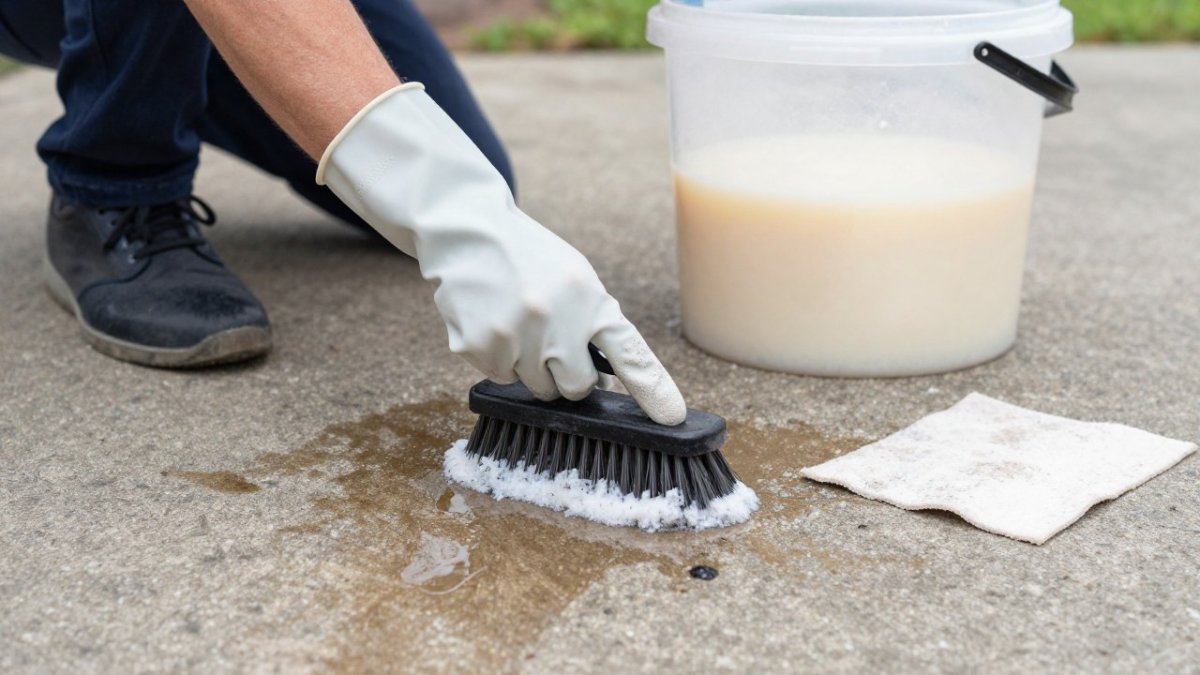
Apply your chosen cleaner neat or diluted as the label directs, working it into the stain with a stiff-bristle brush. Then leave it alone.
Scrub again, then rinse thoroughly with clean water. A pressure washer helps on driveways and patios, but keep the nozzle moving and don’t strip a sealer by holding it too close.
If the concrete still looks patchy after several rounds, professional cleaning and sealing may be worth considering.
Choosing a Concrete Oil Stain Remover: What to Look For
The right concrete oil stain remover matches three things: stain age, oil type and surface finish. Get those wrong and you waste money on a product that either underperforms or damages the slab.
Read the label like a formulator
Degreasers for concrete fall into four broad families, and each behaves differently on a porous alkaline substrate:
- Alkaline detergents (high pH). These saponify fats and cooking oils and lift them into suspension so they can be rinsed away. They are the workhorse for grease, food oil and general driveway grime on bare concrete. They are less effective on polymerised engine oil that has oxidised into a varnish-like film.
- Solvent-based degreasers. These dissolve petroleum oils, hydraulic fluid and gear oil directly. They penetrate faster than water-based products but evaporate, so dwell time is shorter and re-wetting is often needed. On sealed concrete, strong solvents can soften or cloud the sealer.
- Microbial and enzyme cleaners. These contain live cultures or enzymes that metabolise oil residue over days to weeks. They are slow but keep working after the surface is dry, which suits deep, unsealed stains where you want ongoing breakdown rather than a one-off lift.
Check the dilution ratio on the label, as a concentrate and a ready-to-use product can differ considerably in cost per treatment.
Match the product to the stain and the slab
Use this as a decision guide rather than a shopping list:
| Stain situation | Best cleaner type | Why | Watch out for |
|---|---|---|---|
| Fresh engine oil on bare concrete | Solvent or alkaline degreaser | Solvent cuts the oil fast; alkaline lifts it into suspension | Over-wetting, which pushes oil deeper |
| Old, embedded stain | Poultice or microbial cleaner | Poultice draws oil out; microbes break it down over time | Expecting one application to work |
| Cooking oil or grease | Alkaline detergent | Saponifies fats efficiently | Letting it dry before rinsing |
| Sealed or polished surface | pH-compatible cleaner | Preserves the sealer or polish | Harsh solvents stripping the sealer |
| Large driveway spill | Concentrated degreaser | Cost-effective across a big area | Runoff reaching stormwater drains |
| Painted or coated concrete | Mild detergent, spot-tested | Aggressive products lift paint and coatings | Solvent attacking the coating |
Check surface compatibility before you buy
Concrete is not one surface. Bare, sealed, polished, stamped and exposed-aggregate finishes all react differently. On sealed or polished concrete, choose a pH-compatible cleaner and spot-test in an inconspicuous corner first, apply a small amount, leave it for the full dwell time, rinse and check for dulling, clouding or tackiness once dry.
If your concrete has a polished finish, it’s worth understanding what polished concrete flooring involves before you treat it, since some cleaners dull the shine permanently.
What to ignore on the label
Marketing terms like “heavy duty”, “industrial strength” and “professional grade” are not regulated and tell you nothing about formulation. Look instead for the active ingredient class, dilution ratio, recommended dwell time and any surface restrictions.
Watch out: mixing an alkaline degreaser with an acid cleaner, or adding bleach to a solvent product, can release hazardous gases and damage the concrete. Never combine products hoping for a stronger result.
How to Remove Old Oil Stains from Concrete
Old oil stains need patience, not brute force. Once oil has soaked deep into a porous surface, surface cleaning only lifts the top layer, and the stain wicks back within days. The mistake most people make is escalating chemical strength instead of changing method.
The poultice method, step by step
The most reliable method for how to remove old oil stains from concrete is a poultice. It works by capillary action: as the paste dries, it draws oil out of the pore structure and into the absorbent carrier.
- Pre-clean the surface. Scrub the stain with a degreaser and rinse, so the poultice contacts concrete rather than a film of surface oil.
- Mix the poultice. Combine an absorbent powder, diatomaceous earth, fuller’s earth, talc or a proprietary poultice powder, with a solvent or detergent to form a thick paste, roughly the consistency of peanut butter. Fine powders draw more effectively than coarse sand or cat litter.
- Apply thickly. Spread the paste 6-10 mm thick over the stain, extending 25-50 mm beyond the visible edge, because oil spreads wider than the stain shows.
- Cover and leave. Cover with plastic film and tape the edges, then leave it for 24 hours or more; for deep stains, 48 hours is common. The cover slows drying so the solvent has time to dissolve oil before the carrier draws it up.
- Uncover and dry. Remove the plastic and let the paste dry completely. As it dries, it pulls oil upward.
- Scrape and dispose. Scrape the dried poultice into a sealed bag and dispose of it as oil-contaminated waste, not in the garden.
- Repeat if needed. Deep stains often need two or three cycles; the stain should visibly lighten each time.
A common pattern is that the first poultice lifts the most oil and subsequent cycles lift progressively less. If the third cycle produces no visible change, the remaining mark is likely a permanent shadow rather than removable oil.
Microbial cleaners for the long game
Microbial cleaners contain oil-eating microbes that break down oil residue over weeks rather than minutes. They suit bare concrete and are gentler on the surrounding area. Apply according to the label, keep the surface damp for the first few days, and expect results over two to four weeks. They are a good follow-up after a poultice has removed the bulk of the oil, because they keep working in the pores after the surface is dry.
What actually works, and what does not
Some popular home remedies are worth a try on light stains but will not touch old, penetrated oil:
- Boiling water poured directly onto the stain before applying cleaner can help open the surface and soften the oil. It is a useful pre-treatment, not a standalone fix.
- Baking soda or cat litter as a dry absorbent lifts fresh surface oil well but does nothing for oil already below the surface.
- Dishwashing liquid is a mild alkaline detergent and works on fresh cooking oil, but its surfactant load is too low for old engine oil.
Set realistic expectations
Not every stain can be removed. Concrete is porous and oil penetrates deeply; a stain in place for years may leave a permanent shadow even after the oil itself is gone. A realistic outcome for a deep old stain is significant lightening rather than a return to new-concrete appearance. If the stain is still visible after three poultice cycles and a microbial treatment, the remaining mark is likely discolouration of the concrete itself.
When to stop DIY and call a professional
If you have tried the steps above and the stain persists, review our services to see how we handle stubborn stains and surface restoration. You can also contact us to ask about treatment options or request a quote for your concrete.
Picking the Best Degreaser for Concrete Driveway Surfaces
A degreaser for concrete driveway use has to handle volume, weather and traffic.
For a typical driveway, a concentrated alkaline degreaser is the practical default. Dilute it according to the label, apply with a garden sprayer or watering can, scrub with a stiff-bristle brush and rinse well.
Watch out: letting degreaser dry on the concrete leaves a chalky film that traps dirt. Keep the surface wet throughout the dwell time.
If you’re planning to coat the concrete afterwards, degreasing is only half the job. A proper coating needs a clean, sound surface, and you can learn more about garage epoxy flooring once the concrete is clean.
Environmental and Wastewater Precautions
Wastewater from concrete cleaning carries oil, cleaner residue and suspended solids, and in most areas it must not flow into stormwater drains, which typically lead to waterways without treatment.
Practical precautions:
- Rinse onto a lawn or garden bed where the runoff can break down, not into the street gutter.
- Capture heavily contaminated runoff with absorbent material and dispose of it properly.
- Choose a microbial or water-based formula where runoff is a concern.
Check with your local council on wastewater disposal rules for cleaning products before you start a large job.
When to Stop DIY Treatment and Call a Professional
If you’ve tried the steps above and the stain persists, review our services to see how we handle stubborn stains and surface restoration.
Concrete oil stains are a maintenance problem, not a permanent one, but they need the right approach rather than the strongest bottle. Garage Floor Coatings has over 20 years of experience with epoxy, polyurethane and flake systems.
Frequently Asked Questions
What is the best degreaser for oil stains on concrete?
There is no single best product for every situation. For fresh spills, an absorbent material followed by a concentrated alkaline degreaser works well. For embedded stains, a poultice-style concrete oil stain remover draws oil out of the pores. For sealed or coated concrete, choose a pH-compatible cleaner and spot-test first, because strong solvents can strip sealers. Match the product to the stain age, oil type and surface condition rather than buying the strongest cleaner on the shelf.
How long should degreaser sit on an oil stain?
Dwell time depends on the product, so follow the label directions. Heavily embedded or old stains may need longer, and some poultice products are left on for an extended period. Never let a cleaner dry on the surface, because it can leave a residue or damage the concrete. Reapply if the product starts to dry, then scrub with a stiff-bristle brush and rinse thoroughly.
Can you use dishwashing liquid to remove oil from concrete?
Dishwashing liquid is a mild household cleaner that can lift light, fresh oil residue from a hard surface, but it will not penetrate a porous surface to reach embedded oil. It works best as a first pass on a fresh spill, combined with an absorbent material and a scrub with a stiff-bristle brush. For older or set-in stains, a dedicated concrete cleaner or poultice is more effective than repeated dishwashing liquid treatments.
Will a pressure washer remove oil stains from concrete?
A pressure washer can rinse away loosened oil residue and cleaner, but it will not remove oil that has soaked into the concrete. In fact, blasting a dry stain can drive oil deeper into the pores. Use the pressure washer after applying a degreaser and allowing dwell time, and keep the nozzle moving to avoid etching the surface. For sealed or epoxy-coated concrete, use lower pressure and check the coating for damage first.
