Quick Summary
The best garage gym flooring for sound reduction is dense rubber, because it absorbs heavy impacts before they reach the slab. For the strongest results, pair a thick rubber top layer with a resilient underlay that breaks the vibration path into the building.
- Rubber absorbs heavy impacts better than foam or PVC and holds its shape under load.
- For regular bumper-plate work, a 10-15 mm dense rubber top layer is the common choice.
- A resilient acoustic underlay damps vibration better than a single mat of the same height.
- Thickness alone tells you little; check the density rating and test method behind any noise claim.
- Test before and after with an identical drop from the same height, using a light object first.
Table of Contents
- Why Garage Gym Flooring Matters for Sound Reduction
- Rubber Gym Flooring for Soundproofing: Rolls Versus Tiles
- Foam, PVC and Rubber: Comparing Flooring Materials
- Gym Flooring Thickness for Weights and Measured Sound Performance
- Choosing Flooring for Garage Gym Concrete Slabs
- How to Reduce Noise From a Home Gym Beyond the Floor
- Installation Pitfalls and How to Test Sound Safely
- Booking a Garage Floor Assessment in Your Next Step
- Frequently Asked Questions
Why Garage Gym Flooring Matters for Sound Reduction
Garage gyms are loud. Dropped weights, racked barbells and jumping sets send vibration straight through a concrete slab, and neighbours or family upstairs hear every impact. Last Updated: October 27, 2026
The right garage gym flooring reduces noise in two ways. A dense, resilient layer absorbs impact before it reaches the slab, and a well-chosen underlay damps the vibration that would otherwise travel through the building. Flooring alone rarely silences a gym, but it makes the largest single difference.
Many home trainers assume thicker always means quieter. If you’re weighing concrete-based options, you can explore our polished concrete floor service as an alternative to resilient gym flooring. That is only partly true. Thickness helps, but density and the way the layers sit on the slab matter just as much.
Rubber Gym Flooring for Soundproofing: Rolls Versus Tiles
Rubber is the most common choice for sound control, and it comes in two main formats. Rolls cover large areas with few seams. Tiles interlock and are easier to lift, replace or reconfigure.
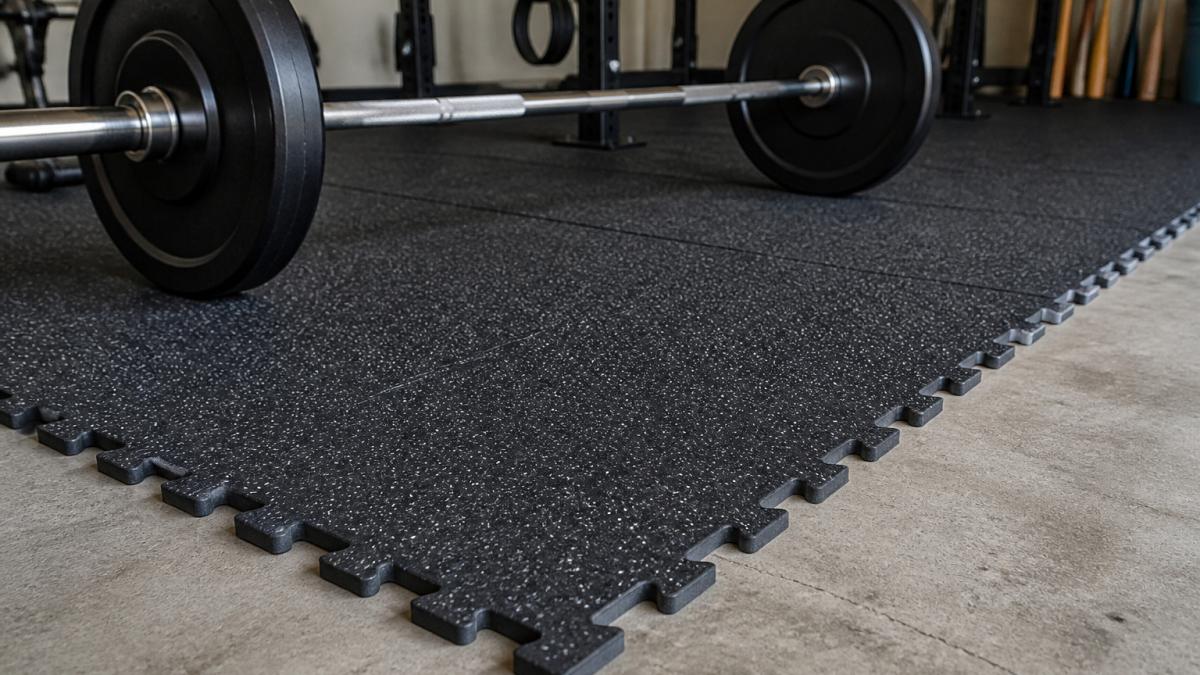
Rolls suit a garage where the layout is fixed and the training zone is large. Tiles suit people who move equipment around or want to replace only the worn section. For sound reduction, both formats perform similarly when they have the same thickness and density.
Watch out: thin rubber rolls can feel quiet underfoot but still transmit heavy impacts. If you drop weights regularly, favour a thicker, denser product.
!Close-up of thick black rubber gym tiles interlocked on a concrete garage floor, with a barbell resting nearby
Foam, PVC and Rubber: Comparing Flooring Materials
Each material behaves differently under load, so the right choice depends on what you train.
| Material | Sound and impact absorption | Load and weight resistance | Typical use |
|---|---|---|---|
| Foam | Good for light impacts, weak under heavy drops | Compresses over time | Light cardio and stretching areas |
| PVC | Moderate, firmer underfoot | Holds shape well | Light to moderate training |
| Rubber | Strong absorption of heavy impacts | Excellent durability | Weightlifting and dropped loads |
Foam is inexpensive and soft, but it compresses under repeated heavy loads and offers limited protection for dropped weights. PVC is firmer and more stable, yet it reflects more sound than rubber. Rubber is the most effective option for sound reduction and equipment protection, which is why it appears most often in dedicated gym setups.
Gym Flooring Thickness for Weights and Measured Sound Performance
Thickness is the first specification most buyers check, but on its own it tells you very little about how a floor will perform under a dropped barbell. Sound from a garage gym splits into two problems that behave differently, and the flooring has to address both.
Impact noise is structure-borne.
That distinction matters because a thick mat that feels dead underfoot can still transmit a sharp impact into the slab if it is too dense or too thin relative to the load.
As a working guide for a garage gym on a concrete slab:
- 6-8 mm rubber suits light cardio, stretching and bodyweight work. It will not meaningfully protect a slab from dropped dumbbells.
- 10-15 mm rubber is the common choice for mixed training with bumper plates and controlled drops.
- 15-20 mm or thicker, or a thinner tile over an acoustic underlay, is what most practitioners reach for when heavy deadlifts and Olympic lifts are regular and the room sits above or beside living space.
Treat those bands as starting points, not guarantees.
Manufacturers’ noise claims are not standardised, so ask for the density rating and the test method behind any figure. Where a supplier cannot provide either, assume the number is indicative only.
Choose the build-up, not just the tile. A resilient underlay plus a dense rubber top layer usually outperforms a single thick mat of the same total height, because the two layers handle different parts of the impact.
A simple before-and-after sound test you can run yourself
You do not need lab equipment to compare options, but you do need to be honest about what a phone app can tell you. A basic sound-level app measures airborne noise at the microphone; it does not measure structure-borne vibration travelling through the slab. Use it to compare like with like, not to claim a decibel reduction.
- Baseline: with the garage empty, drop a known weight (for example a 20 kg bumper plate) from waist height onto the bare slab three times. Record the app reading and ask someone in the room above or beside the garage to describe what they hear.
- Install the flooring, including any underlay, and let it settle.
- Repeat the identical drop from the same height, in the same spot, at the same time of day.
- Compare the app reading and the listener’s description. A drop in perceived loudness and a shorter, duller thud are the signals that matter.
Keep the test short, use a light object first, and never test by dropping weights on a neighbour’s ceiling or at unsociable hours. The method is comparative, not absolute, it will tell you whether build-up A beats build-up B in your garage, which is the decision you are actually making.
Choosing Flooring for Garage Gym Concrete Slabs
The right build-up depends less on the flooring product than on what the floor is sitting on and what is underneath it. A garage gym in a detached brick garage, a gym on a suspended timber floor over a living room, and a gym in a room above a bedroom all need different answers, and in some cases adding more layers will not help.
Concrete slab on grade
This is the most common garage floor and the easiest to work with. The slab is hard and dense, so it conducts impact noise efficiently into the ground and the surrounding structure. The good news is that a slab on grade has no cavity beneath it to act as a drum, so the main job is to absorb the impact before it reaches the concrete.
- Light use: a 6-8 mm rubber tile or roll laid directly on a clean, dry slab is adequate.
- Regular heavy lifting: a resilient acoustic underlay beneath a 10-15 mm dense rubber top layer gives noticeably better vibration damping than a single mat.
- Heavy deadlifts and Olympic lifts: add a dedicated lifting platform or a thicker build-up in the lifting zone rather than thickening the whole floor.
Check the slab for moisture before laying anything. A simple plastic-sheet test, taping a square of polythene to the slab for 24 hours and checking for condensation, will flag a damp slab that would otherwise ruin adhesives and underlays. Cracks and level changes should be filled and flattened first, because a rocking tile rattles and transmits more noise than a flat one.
Suspended floors and rooms above living spaces
A suspended floor behaves very differently. The floor structure itself can resonate, and impact energy travels through the joists into the ceiling below. This is where a decoupling layer earns its keep: a resilient underlay or isolation mat breaks the path between the rubber top layer and the floor structure, reducing how much vibration reaches the room below.
A practical build-up for a room above a living space is a dense rubber top layer over a resilient acoustic underlay, with the edges kept slightly clear of the walls so the floor does not bridge into the structure. In some cases a floating build-up, flooring laid over an isolation layer rather than bonded down, performs better than a glued system, because it is not rigidly connected to the floor.
Adding layers is not always an improvement. On a suspended floor, a very stiff, heavy build-up can increase the mass that the structure has to carry without adding enough decoupling to help. If the floor already feels springy or the joists are undersized, get the structure checked before adding weight.
When added layers will not help
More flooring cannot fix every noise problem. If the dominant noise is airborne, plates clanging, a rack rattling, music, a thicker floor will do little. If the building transmits sound through shared walls, ceilings or flanking paths, flooring addresses only part of the chain. And if the slab is damp or uneven, adding layers on top will simply trap moisture and create a rocking, rattling surface.
Trade-offs to plan for
- Compression: softer, thicker foam and low-density rubber compress over time under racks and dropped loads, so the floor loses performance where you need it most. Dense rubber holds its thickness better.
- Seams: interlocking tiles can let vibration and moisture through at the joints. Tight-fitting edges and a consistent subfloor reduce this.
- Moisture and odour: some rubber products off-gas for days after installation. Ventilate the garage and allow the flooring to settle before regular use.
- Trip edges: a thick tile creates a lip at the garage door and at the boundary with a coated slab. Plan a ramp or transition strip.
- Stability under racks: a rack sitting on a compressible floor will rock. Put racks on a solid base or a dedicated platform rather than directly on soft matting.
If your garage doubles as a workshop, a sealed concrete surface is easier to clean and works well as a base beneath a rubber top layer. You can read more about our Garage Epoxy Flooring options.
How to Reduce Noise From a Home Gym Beyond the Floor
Flooring handles the largest share of impact noise, but sound also travels through walls, ceilings and the air. Several simple steps reduce the rest.
- Keep the training zone away from shared walls where possible.
- Hang acoustic panels or heavy curtains on walls that face living spaces.
- Use bumper plates and lower weights carefully rather than dropping them.
- Seal gaps around doors and garage roller doors to block airborne noise.
- Place a thick rubber mat under cardio machines to isolate their vibration.
Many home gyms benefit most from combining a good floor with one or two of these measures.
Installation Pitfalls and How to Test Sound Safely
The most common mistake is laying flooring over a damp or uneven slab. Moisture can cause adhesives and underlays to fail, and uneven surfaces let tiles rock and rattle. Check the slab before you buy, and allow time for it to dry.
Watch out: do not test impact noise by dropping heavy weights on a neighbour’s floor or during unsociable hours. Test with a light object at first, and keep sessions short.
Installation also involves downtime. Some sealed or coated surfaces need time to cure before they can take load, so plan the schedule around your garage use. You can read about cure times and downtime in Garage Flooring Downtime: Full Cure Times Explained.
Booking a Garage Floor Assessment in Your Next Step
The best floor depends on your slab, your training and your building. To arrange an assessment of your garage floor, contact us to discuss your next step.
Frequently Asked Questions
What is the best flooring for a garage gym to reduce noise?
Sound performance varies by product, so ask suppliers for their tested impact or acoustic ratings before you buy.
Does rubber gym flooring reduce sound and vibration?
Yes, rubber gym flooring reduces both impact noise and vibration, though the amount depends on thickness, density and what sits underneath. Rubber decouples the impact of a dropped weight from the concrete slab, which is where most transmitted noise and vibration originate. Product listings often describe general noise and shock absorption, but published measured figures are limited, so treat claims cautiously. Testing a sample section in your own space is the most reliable way to judge performance.
Can I install sound-reducing gym flooring over a concrete garage floor?
Check the surface for moisture, as damp concrete can trap water beneath the flooring and encourage mould. Follow the manufacturer’s installation guidance for your product.
Note: The [Garage Flooring Downtime: Full Cure Times Explained] link has been included as a placeholder to a related article on the site. Please confirm the URL before publishing.
