Last Updated: November 4, 2026
Quick Summary
Epoxy flooring for basement moisture works only when the slab is tested and dry enough to hold the coating, because water vapour pushing up through concrete causes bubbles, blisters and peeling. Test the slab first, then add a surface-applied vapour barrier primer if readings exceed the product’s tolerance.
- Epoxy is a coating, not a dam, so it only works on a slab dry enough to hold it.
- The in-situ relative humidity probe is the most reliable test for basements.
- Test in the dampest season and at multiple points, at least one per 50 square metres.
- A surface-applied vapour barrier primer is the practical fix for existing basements.
- For small blisters under 20 mm, a patch repair with moisture-tolerant epoxy can work.
Table of Contents
- Why Basement Moisture Destroys Epoxy (and How to Tell If You Have It)
- Concrete Moisture Testing Methods That Decide If Epoxy Can Go Down
- Moisture Vapour Barrier for Concrete: When You Need One and What It Does
- Epoxy Floor Peeling Causes: Bubbles, Blisters and Whitening Explained
- Choosing the Right Epoxy System for a Damp Basement
- Installation Day: What a Moisture-Safe Basement Epoxy Job Involves
- Book a Moisture Assessment Before You Commit to Epoxy
- Frequently Asked Questions
Why Basement Moisture Destroys Epoxy (and How to Tell If You Have It)
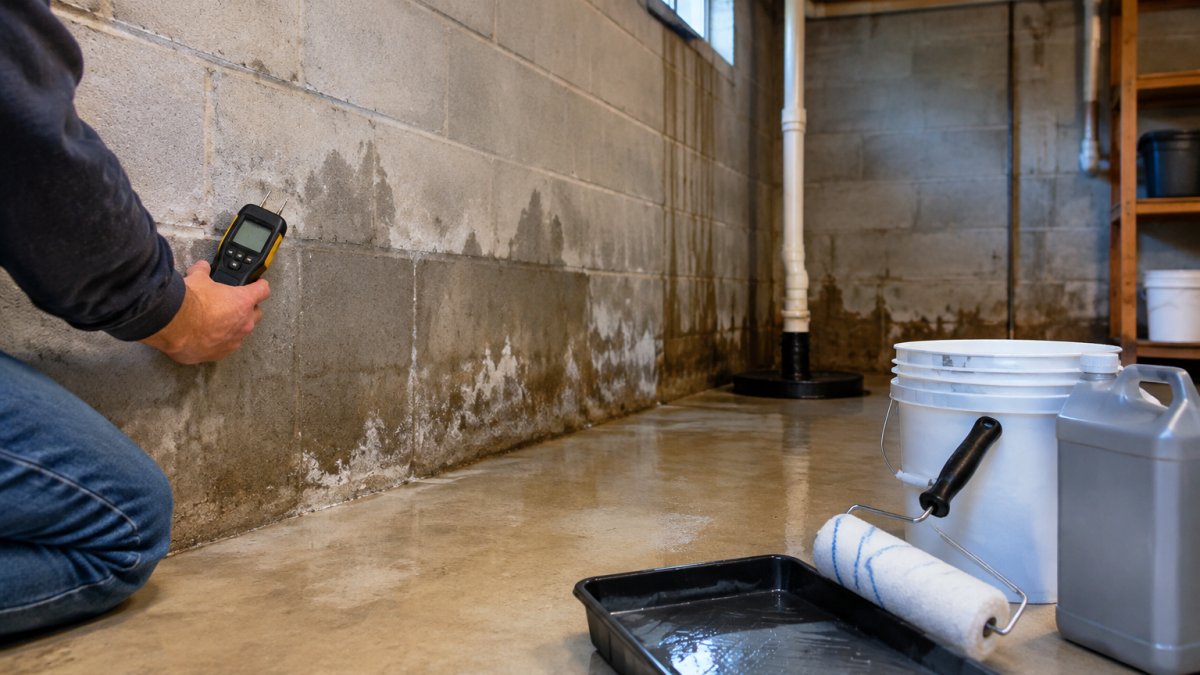
Epoxy flooring for basement moisture fails for one reason: water vapour pushing up through the slab from below. Water vapour moving through concrete creates hydrostatic pressure, and that pressure has to go somewhere. It goes straight through your new coating.
This guide covers how to test for that moisture, when you need a vapour barrier, and how to choose a system that survives a damp slab.
The numbers explain why this matters. According to Mordor Intelligence’s flooring market analysis, epoxy accounted for over 41% of floor and associated repair costs in the studied market, a sign of how widely these systems are used and how costly it is when they fail. Most of those failures trace back to moisture that was never measured.
Here is what most guides get wrong. They treat epoxy as a waterproofing product. It is not.
Epoxy flooring for basement moisture control is a coating, not a dam. Once cured, epoxy forms a continuous, non-porous barrier that resists water, chemicals and stains (BPS Southeast’s waterproof flooring review). But that barrier only works if the slab underneath is dry enough to hold it.
How to tell if you have a moisture problem:
- Damp patches or dark stains on bare concrete that fade and return
- White powdery deposits along the base of walls
- Musty smells that get worse in humid weather
- Paint or old coatings lifting at the edges
- A slab that feels cold and clammy year-round
If you spot two or more of these, test before you coat. Skip the test and you are gambling with the whole floor.
Concrete Moisture Testing Methods That Decide If Epoxy Can Go Down
Concrete moisture testing measures how much water vapour escapes the slab before a coating goes down. The result decides whether epoxy can be installed at all, and which system you can use.
Epoxy coatings are installed over concrete that has been tested for moisture. Most manufacturers specify a maximum moisture vapour emission rate (MVER) and a maximum relative humidity (RH) inside the slab, and these limits differ between products. Confirm the figures against the specific product data sheet before installation rather than relying on a generic rule of thumb.
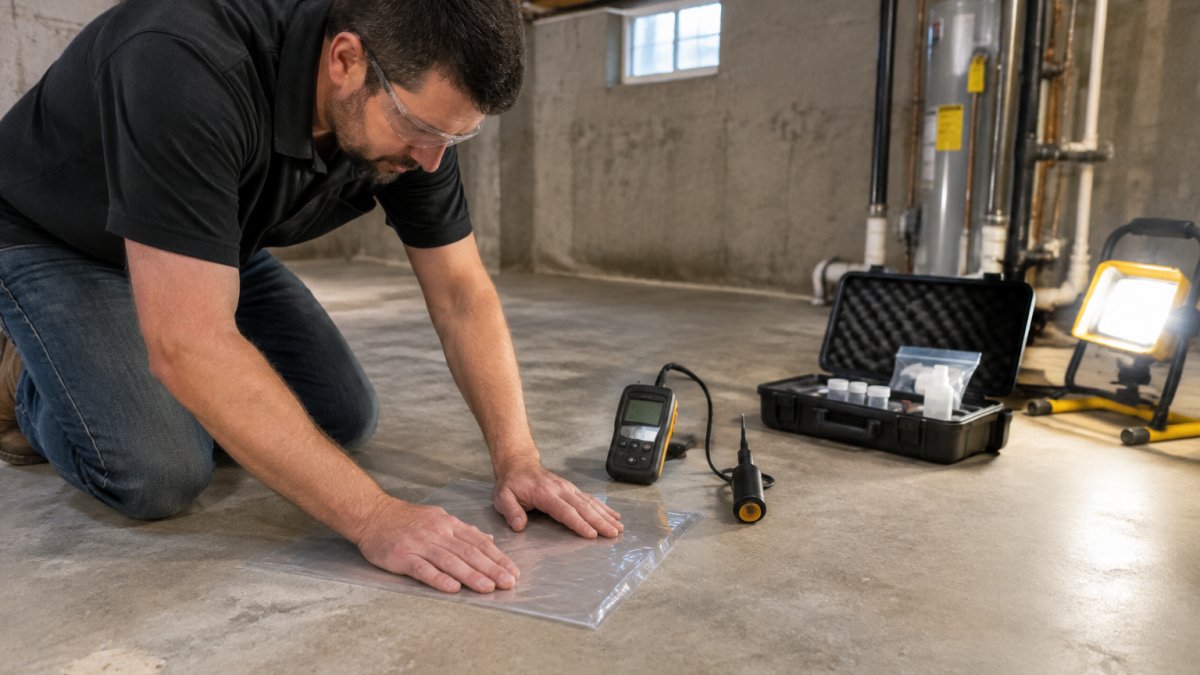
There are three common test methods, and they answer different questions:
- Calcium chloride test. A dish of desiccant sits sealed under a plastic dome for 60 to 72 hours. It measures the rate at which moisture vapour escapes the surface. It is cheap and widely available, but it only reads the top 10 to 20 mm of concrete and is sensitive to site conditions. It does not tell you what is happening deeper in the slab.
- In-situ relative humidity probe. A hole is drilled to a specified depth (typically 40% of the slab thickness) and a probe measures humidity inside the concrete. This is the most reliable method for basements because it reflects the moisture that will actually migrate to the coating interface.
- Plastic sheet test. A sheet taped down for 24 hours shows whether vapour collects underneath. It is a rough indicator, not a measurement, and it should never be the only test before a coating install.
Run the test in the dampest season, not the driest. A slab that passes in a dry month can fail in winter. For a basement, also test at multiple points, at least one per 50 square metres and one near each wall, because moisture profiles vary across a slab.
If test results exceed the product tolerance, you have three options: specify a moisture-tolerant system, apply a surface-applied vapour barrier primer, or carry out remedial waterproofing and drainage before any coating. The test tells you which path you are on.
Moisture Vapour Barrier for Concrete: When You Need One and What It Does
A moisture vapour barrier for concrete is a membrane that stops water vapour moving from the ground into the slab and up into the coating. You need one when the slab has no barrier underneath, or when test results sit above the coating’s tolerance.
Two options exist:
- Under-slab barrier. Installed below the concrete during construction. If your home lacks one, you cannot add it without removing the slab.
- Surface-applied barrier. A primer or coating applied directly to the slab before the epoxy. This is the practical fix for existing basements.
A surface barrier slows vapour and gives the epoxy a stable base. It does not fix active water leaks. Watch out: no barrier or coating will hold back a slab with running water beneath it. That needs drainage or waterproofing work first.
Epoxy Floor Peeling Causes: Bubbles, Blisters and Whitening Explained
The main epoxy floor peeling causes all come back to moisture trapped under the coating, but not every blister is a moisture problem. Distinguishing the two matters because the repair is different.
The signs appear in a predictable order:
- Bubbles. Small domes lift off the surface as vapour collects. They often appear within 24 to 72 hours of application.
- Blisters. Larger pockets form, often in the centre of the floor where the slab is thickest and slowest to dry.
- Whitening. A cloudy, milky haze appears where moisture sits under the film. This is amine blush or moisture entrapment in the curing film.
- Peeling. The coating lifts and flakes away in sheets, usually starting at edges, cracks or control joints.
According to Pour La Epoxy’s analysis of moisture under epoxy floors, moisture trapped under epoxy is the primary cause of these failures, including bubbles, blisters, whitening and peeling. Hydrostatic pressure drives it.
How to tell moisture failure from application failure:
- Moisture-driven. Blisters appear across the whole slab, worsen in humid weather, and return after repair if the moisture source is not addressed. The underside of the peeled film is often damp or shows a white powdery residue.
- Application-driven. Bubbles cluster in one area, follow a roller pattern, or appear where the coating was applied too thin or in direct sun. The underside is dry and the concrete surface may show grinding marks or contamination.
Other causes exist, but they are secondary:
- Applying epoxy over a dirty, sealed or previously coated slab
- Coating too thin (below the manufacturer’s specified film thickness)
- Cold application temperatures (below 10°C for most standard epoxies)
- No moisture test before install
- Amine blush from a poorly mixed or humidity-affected primer
If peeling has already started, a fresh topcoat will not fix it. The moisture has to be addressed first, or the new layer fails the same way. The repair sequence is: strip the failed coating back to bare concrete, re-test the slab, address the moisture source (barrier primer, drainage or waterproofing), then re-coat with a moisture-tolerant system. For small blisters under 20 mm, a patch repair with a moisture-tolerant epoxy can work, but only if the surrounding floor passes a moisture test.
Watch out: sanding back a blister and spot-coating it without re-testing the slab is the most common way a repair fails twice. The moisture that caused the first blister is still there.
Choosing the Right Epoxy System for a Damp Basement
For a damp basement, choose a system built for moisture tolerance, not just a standard garage kit. Moisture-resistant epoxy and polyaspartic systems are designed to handle basement humidity and cooler temperatures (Garage Floor Coatings’ 2026 design trends review).
Here is how the main options compare:
| System | Moisture Tolerance | Cure Speed | Best For |
|---|---|---|---|
| Standard epoxy | Low | 24-48 hours | Dry slabs only |
| Moisture-resistant epoxy | High | 24-48 hours | Damp basements |
| Polyaspartic | High | 2-4 hours | Fast turnarounds, cold rooms |
| Epoxy with flake finish | Medium-high | 24-48 hours | Hiding slab flaws |
You can review the epoxy resin floor systems we install to match one to your slab. If speed matters, compare polyaspartic flooring as a faster-curing, moisture-tolerant alternative. For a decorative finish that also hides minor surface flaws, look at colour flakes.
Installation Day: What a Moisture-Safe Basement Epoxy Job Involves
A moisture-safe install follows a fixed sequence. Skipping a step is how coatings fail.
- Test the slab. Confirm the moisture reading before anything else.
- Grind the surface. Diamond grinding opens the concrete so the coating bonds.
- Fill cracks and pits. Repair damage so the base is flat and sound.
- Apply the barrier or primer. Seal the slab against vapour.
- Roll the base coat. Build the main film thickness.
- Add flake or topcoat. Finish with a protective layer.
- Cure and inspect. Check for bubbles before handover.
Two things decide the outcome: surface prep and moisture control. Everything else is finish work.
Our professional installation team can be contacted about installation, including preparation and application. Project timelines depend on size and cure times, so request a quote for your specific project.
Book a Moisture Assessment Before You Commit to Epoxy
The test comes before the quote, not after. A moisture assessment tells you whether epoxy is the right floor for your basement or whether you need barrier work first.
We have over 20 years of experience coating concrete across residential garages, workshops, warehouses and showrooms, using epoxy, polyurethane and flake systems.
If you are ready to move, contact us to discuss your project.
Frequently Asked Questions
Does epoxy flooring prevent moisture coming up through concrete?
Once fully cured, epoxy forms a continuous, non-porous barrier that resists water, chemicals and stains. It does not, however, stop active water intrusion. Coating performance depends on the moisture vapour emission rate (MVER) of the slab, which differs between products. Test the slab first, then choose a system rated for your reading.
Do I need a moisture vapour barrier before applying epoxy to my basement floor?
It depends on your test results. If the slab reads within the coating manufacturer’s MVER limit, a barrier may not be required. If readings are high or hydrostatic pressure is present, a moisture vapour barrier for concrete, or a moisture-tolerant primer system, is essential. Applying epoxy directly over a wet slab is one of the most common epoxy floor peeling causes.
How do I test my basement concrete for moisture before coating?
Concrete moisture testing methods include calcium chloride tests, in-situ relative humidity probes and plastic sheet tests. The calcium chloride method measures vapour emission, while in-situ probes read moisture deep in the slab. A simple plastic sheet taped to the floor for 24 hours can reveal condensation, but it is indicative only. Test the slab to confirm it falls within the limit specified for the coating product before any coating goes down.
What are the signs of hydrostatic pressure in basement floors?
Look for white powdery deposits (efflorescence), damp patches that darken after rain, lifting or bubbling coatings, and a musty smell. These suggest moisture is being pushed up through the concrete. If you see these signs, arrange concrete moisture testing methods before applying epoxy. Ignoring them risks the coating failing within months. A moisture vapour barrier for concrete or a moisture-tolerant system may be needed to manage the pressure.
Your basement floor is only as good as the slab beneath it. Get the moisture reading right and the coating lasts. Get it wrong and you pay twice. Get started with Garage Floor Coatings and book a moisture assessment before you commit to a single coat.
