Last Updated: November 4, 2026
Quick Summary
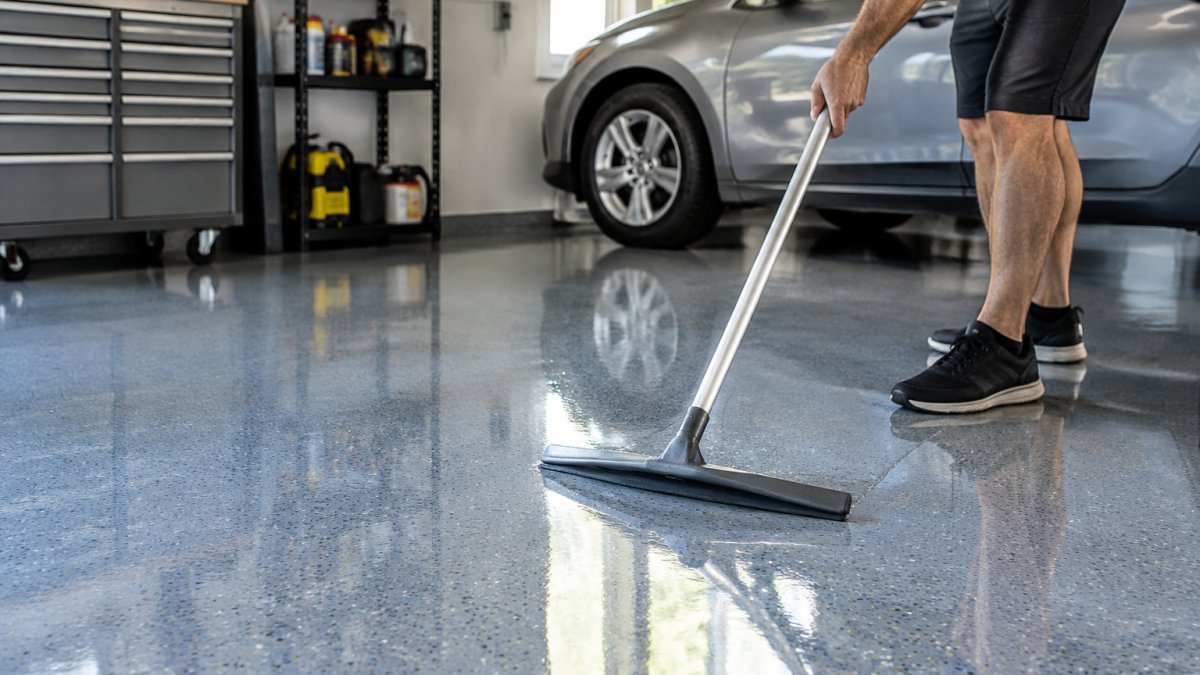
To maintain a high gloss epoxy garage floor, sweep or dust mop three to four times per week to stop grit from scratching the surface. Then wet clean the high-traffic lanes weekly with a pH-neutral cleaner and a soft microfibre mop, rinsing and drying afterwards. Avoid acidic cleaners, vinegar and abrasive pads, which can dull the finish.
- Sweep or dust mop three to four times per week to stop grit grinding into the surface.
- Wet clean tyre lanes and the door-to-car path weekly with a pH-neutral cleaner.
- Use a soft microfibre mop and change rinse water often to avoid spreading dirt.
- Avoid acidic cleaners, citrus solutions, vinegar, ammonia and steel wool, which can etch or dull the surface.
- Clean oil and fuel spills promptly by blotting first, then using a degreaser suited to epoxy floors.
Table of Contents
- Why High Gloss Epoxy Dulls and How Grit Causes It
- Tools You Need for Routine Epoxy Floor Cleaning
- Step-by-Step Routine Cleaning for a Glossy Finish
- Best Cleaning Products for Epoxy Floors and What to Avoid
- How to Remove Tyre Marks and Spills Without Dulling the Surface
- Epoxy Floor Maintenance Schedule: Daily, Weekly, Seasonal and Yearly
- Restoring Gloss, DIY Polishing or Calling a Professional
- Book a Gloss Check for Your Garage Floor
- Frequently Asked Questions
Dull, scuffed epoxy in a garage is rarely the result of bad installation. In most cases, it is grit. Tiny particles of sand, dirt and road dust get dragged across the surface by tyres and boots, and every pass grinds them deeper into the coating.
This guide covers why grit causes dulling, what tools to buy, how to clean step by step, which products to avoid, how to handle tyre marks and spills, a maintenance schedule, and when restoration or professional help makes sense.
Why High Gloss Epoxy Dulls and How Grit Causes It
Epoxy gives a garage floor its hard, reflective shine. That shine depends on a smooth, unbroken top layer. The moment that layer gets scratched, light scatters instead of bouncing back, and the floor looks hazy.
Grit is the main cause. Sweeping or dust mopping three to four times per week helps stop grit grinding into the surface and causing dulling.
Two other things speed up dulling. Wet grit is worse than dry grit, because mud acts like sandpaper once it dries. Tyres also carry abrasive road grime across the floor every time a car pulls in.
Tools You Need for Routine Epoxy Floor Cleaning
You do not need much equipment, but cheap brushes or rough mops can scratch the very finish you are trying to protect.
- Microfibre dust mop: Traps fine dust without scattering it. Choose a flat head that is wide enough for your bay.
- Soft-bristled push broom: Useful for loose debris, leaves and gravel from shoes. Avoid stiff bristles.
- Two buckets: One for clean water and cleaner, one for rinse water.
Store tools so they stay clean. A mop head full of grit from last week will scratch the floor next time.
Step-by-Step Routine Cleaning for a Glossy Finish
- Clear the floor. Move vehicles, tools and boxes so you can reach every corner. About 10 minutes.
- Dry sweep or dust mop. Start at the far wall and work toward the door. Lift the mop head rather than dragging it back, so you do not push grit around. About 15 minutes.
- Pay attention to high-traffic lanes. Tyre tracks and the path from door to car collect the most grit. Sweep these more thoroughly.
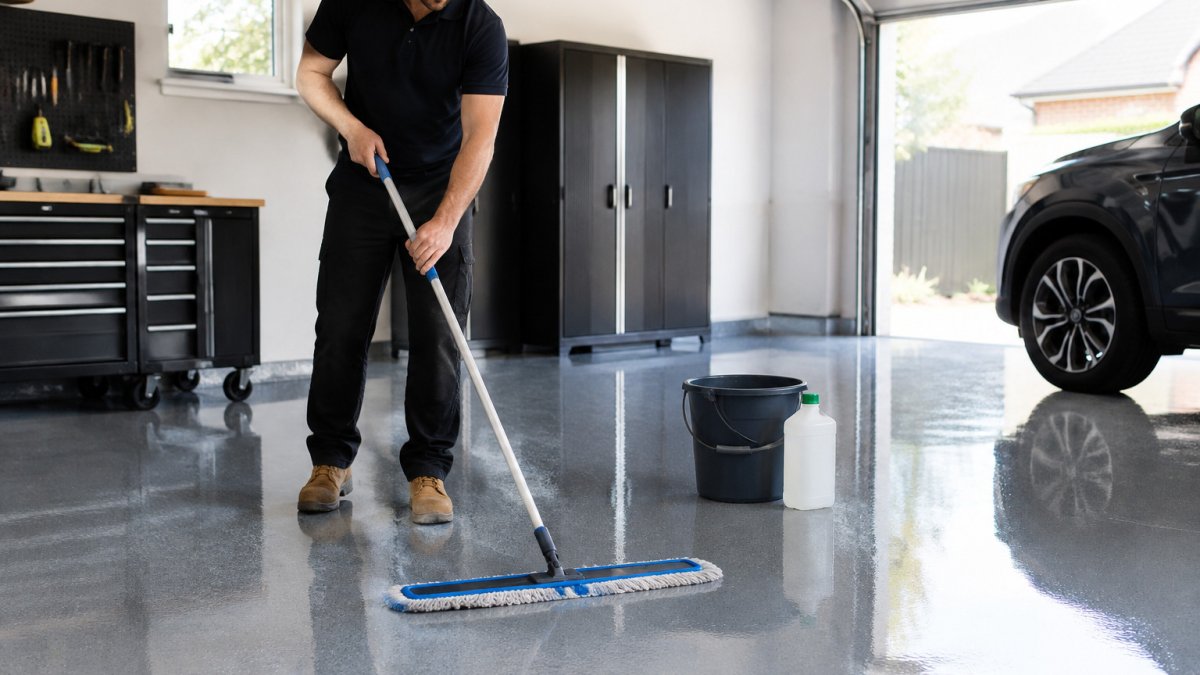
- Mix a pH-neutral cleaner. Use a cleaner made for epoxy floors and follow the dilution on the label. Warm water helps lift oils and dirt.
- Wash in small sections. Apply the solution with a microfibre mop, about one metre at a time. Avoid soaking the surface.
- Scrub high-traffic areas gently. Use a soft deck brush on tyre lanes and dull spots. Scrubbing high-traffic areas at least once a week helps keep the coating in good condition.
- Rinse with clean water. Change the rinse water often so you are not spreading dirty water back onto the floor.
- Remove standing water. Use a squeegee or dry mop immediately. Water left in low spots or corners can affect the finish over time.
- Let the floor dry fully. Keep vehicles off until dry, and avoid walking on it with dirty shoes.
Watch out: Never skip the dust-off step and go straight to wet mopping. Wet mopping over loose grit smears it into a fine film and can leave the floor looking dirtier than before.
Best Cleaning Products for Epoxy Floors and What to Avoid
The right cleaner keeps the resin’s chemistry stable. The wrong one can etch the surface and leave a hazy patch that no amount of scrubbing removes.
Use:
- A pH-neutral floor cleaner made for epoxy or resin surfaces
- A mild degreaser for oil spots, applied and rinsed promptly
- Plain warm water for routine mopping
Avoid:
- Acidic cleaners, which can chemically etch the resin
- Citrus-based solutions, which can leave a film or dull the finish
- Vinegar, which is acidic and can cause haze over time
Acidic and citrus-based cleaners can etch resin surfaces and dull gloss. Stick to products labelled safe for epoxy, and read the manufacturer’s directions for your coating, because product guidance varies.
How to Remove Tyre Marks and Spills Without Dulling the Surface
Tyre marks and spills are the two most common problems in a working garage. The goal is to lift the mark without scratching the finish, and the method changes with how long the mark has been there and what caused it.
Tyre marks
Tyre marks come from two sources: rubber transfer from hot tyres, which looks like a dark scuff, and the fine grit and road film tyres carry in, which looks like a grey haze in the tyre lanes. Treat them differently.
For fresh rubber scuffs:
- Dust off loose grit first so you are not grinding it in.
- Apply a pH-neutral cleaner to the mark and let it sit for a few minutes.
- Scrub gently with a soft nylon brush in small circles.
- Rinse and dry thoroughly.
- For stubborn marks, repeat rather than scrubbing harder.
For baked-on or older marks:
- Start with a longer dwell time, five to ten minutes of contact does more than extra scrubbing.
- Use a mild degreaser rather than a stronger solvent, and keep it off the surrounding floor as much as possible.
- Work in small sections and rinse before the product dries.
- If the mark persists, a light polishing compound on a soft pad can lift the residue without cutting the top layer. Test on a hidden area first.
For grey grit film in tyre lanes: this is not a stain, it is fine abrasive embedded in the surface. A weekly wet clean with a pH-neutral cleaner and a microfibre mop removes it before it becomes a permanent haze.
Oil and fuel spills
- Blot up as much as possible with an absorbent cloth. Do not wipe, which spreads the liquid.
- Apply a degreaser suited to epoxy floors and let it work for the time stated on the label.
- Rinse with clean water and dry the spot.
- Clean the spill quickly. Oil left to sit can soften some coatings and make marks harder to lift.
Fuel spills need faster action than oil. Petrol and diesel evaporate, but the residue can leave a dull patch if left. Blot, then clean with a pH-neutral cleaner rather than a solvent, and dry promptly.
Coating-specific cautions
- Standard epoxy is the most sensitive to solvents and prolonged contact with oil. Clean spills the same day.
- Polyaspartic topcoats tolerate most mild cleaners well, but still avoid strong solvents that can soften the film.
- Polyurethane topcoats handle fuel and oil residue better, but are more sensitive to standing water, so dry the area fully after cleaning.
Watch out: Do not use an unchecked solvent, and never scrub a dry mark with a stiff brush, both can scratch the top layer and leave a dull patch that no amount of cleaning will fix. Test any new product on a small, hidden area first.
Epoxy Floor Maintenance Schedule: Daily, Weekly, Seasonal and Yearly
A schedule is only useful if it changes with the conditions the floor actually faces. The version below separates the year-round routine from seasonal adjustments, and flags where a polyaspartic or polyurethane topcoat changes the advice.
Year-round baseline
| Frequency | Task | Purpose |
|---|---|---|
| Daily (busy garages) | Sweep or dust mop high-traffic lanes, wipe spills immediately | Stops grit grinding into the surface |
| 3 to 4 times per week | Dust mop or sweep the whole floor | Keeps grit from building up |
| Weekly | Wet clean tyre lanes and the door-to-car path with a pH-neutral cleaner | Removes film and road grime |
| Monthly | Deep clean the whole floor, including corners and edges | Lifts built-up dirt and oils |
| Quarterly | Inspect for chips, cracks, lifting edges and dull patches | Catches early damage before it spreads |
| Yearly | Full coating inspection and restoration plan | Keeps gloss consistent |
Seasonal adjustments
Wet season (winter and early spring). Wet boots and tyres track in mud that dries into an abrasive film.
Dry season (summer). Dust and fine road grit become the main abrasive. Dust mop more often and avoid wet mopping over loose grit, which smears it into a film.
Shoulder seasons. This is the best window for the quarterly inspection and any touch-up work.
Product-specific adjustments
- Standard epoxy. The most scratch-sensitive of the three. Keep the weekly wet clean consistent, and inspect tyre lanes quarterly for the first signs of haze.
- Polyaspartic topcoat. More UV-stable and flexible, so it resists yellowing and hairline cracking better. It can still dull from grit, so the daily sweep matters just as much.
- Polyurethane topcoat. Strong chemical resistance helps around oil and fuel spills, but it can be more sensitive to prolonged standing water. Dry standing water promptly after any wet clean.
What to check at each inspection
Walk the floor in good light and look for four things: dull patches in tyre lanes, scratches that catch a fingernail, lifting or peeling at edges and expansion joints, and small chips. Address chips and lifting edges early, because water and grit get under the coating and speed up failure. A quarterly check takes minutes and prevents the yearly restoration from becoming a full recoat.
Watch out: Do not treat the schedule as fixed. A garage that stores a boat, hosts a workshop or sees daily commuter traffic needs the high-traffic tasks more often than a lightly used single-bay garage.
Restoring Gloss, DIY Polishing or Calling a Professional
Routine cleaning first. Often a thorough deep clean and a fresh round of dust mopping lifts a haze that looks like permanent damage. Try this before anything else.
DIY polishing. A light polishing compound and a soft pad can restore light scratches and minor haze.
Professional restoration. Call a professional when the floor has deep scratches, widespread dulling, chips, peeling or significant staining.
If you are weighing up a professional job, ask about the process and what it covers. Our cleaning and sealing service suits floors that have lost their shine but still have a sound coating, and a polished concrete floor is worth considering if you want a different finish altogether.
Book a Gloss Check for Your Garage Floor
If your epoxy floor looks dull, hazy or scuffed and routine cleaning has not helped, it is worth getting a professional opinion on whether it needs a deep clean, polishing or restoration.
Visit our services page to see what Garage Floor Coatings offers, or read about our garage epoxy flooring service to understand what a professional gloss check covers. When you are ready to arrange a visit, use our contact page.
Frequently Asked Questions
What is the best way to clean high-gloss epoxy floors without scratching?
Sweep or dust mop first with a soft microfibre or modacrylic head so grit does not get dragged across the surface. Then wash with a neutral pH cleaner in warm water using a soft brush or mop, and rinse or squeegee the floor so no water pools in corners. Avoid abrasive pads and stiff brushes, since they leave fine surface scratches that dull the gloss over time. Sweeping three to four times a week is the most effective habit for protecting the finish.
What products should I avoid using on epoxy flooring?
Avoid acidic cleaners, vinegar, citrus-based solutions and ammonia. These can chemically etch the resin and leave a hazy, dull surface that is difficult to reverse. Strong degreasers used undiluted can also break down the topcoat over time, so dilute them and rinse thoroughly. Stick with a pH-neutral cleaner designed for resin floors, and test any new product on a small hidden area first.
How often should I deep clean my epoxy garage floor?
Routine cleaning is best done weekly in high-traffic areas, with daily sweeping where possible. A deeper clean, including degreasing oil spots and checking for chips or peeling edges, is generally recommended monthly or quarterly depending on how heavily the garage is used. A visual inspection every few months helps you catch small damage early, before it spreads and affects the glossy finish.
Keeping a high gloss epoxy floor shining comes down to grit control, gentle cleaning and early attention to damage. Sweep often, clean with pH-neutral products, and deal with spills and tyre marks quickly.
