Last Updated: November 18, 2026
Quick Summary
For many daily-use workshops, polyaspartic coating is a suitable choice because it cures quickly and resists yellowing from sunlight better than epoxy. Epoxy remains a sound option for strictly indoor floors with little UV exposure and a tighter budget. Surface preparation often matters more to the final result than which resin is chosen.
- Polyaspartic coating cures faster, so the floor can return to service sooner.
- Epoxy tends to yellow and chalk in sunlight, so it suits indoor spaces.
- Driving onto a coating before its stated cure window can leave lasting tyre marks.
- A poorly prepared polyaspartic floor will fail faster than a properly prepared epoxy one.
- Check the manufacturer’s chemical resistance chart against the substances your workshop uses.
Table of Contents
- Polyaspartic and Epoxy Coatings: What Each One Is
- Is Polyaspartic Coating Better Than Epoxy for a Workshop?
- Polyaspartic Floor Coating Cure Time and Getting Back to Work
- Chemical, Oil and Spill Resistance: Epoxy Holds Its Own
- Polyaspartic Floor Coating Cost and Lifecycle Value
- Polyaspartic Floor Coating Pros and Cons for Home Workshops
- Booking Your Workshop Floor Assessment
- Frequently Asked Questions
Polyaspartic and Epoxy Coatings: What Each One Is
Polyaspartic is a fast-curing polyurea-family coating, while epoxy is a two-part resin that has long been the default for garage and workshop floors. Both bond to a prepared concrete slab and form a hard, seamless surface, but they cure differently and behave differently under heat, sunlight and heavy wheel loads. UCoat Floor Coating Systems guide on epoxy versus polyaspartic coatings
Epoxy is the older, widely used option. It performs well on indoor floors that do not see strong UV. Its main weakness is yellowing and chalking when exposed to sunlight, so it is better suited to interior spaces. Read about our cleaning and sealing service to keep a newly coated floor in good condition.
Polyaspartic is the newer option. It cures much faster, handles UV exposure with far less discolouration, and tends to resist abrasion well. These strengths make it popular for workshops that are used daily and need to return to service quickly. The performance points below apply to coatings installed on a properly prepared surface.
The two coatings differ in cure speed and how they handle sunlight, as summarised below.
| Coating | Key trait | Best suited to |
|---|---|---|
| Epoxy | Two-part resin; older default | Indoor floors with little UV |
| Epoxy | Yellows and chalks in sunlight | Interior spaces |
| Polyaspartic | Fast-curing polyurea-family coating | Daily-use workshops needing quick return |
| Polyaspartic | Far less discolouration under UV | Sunlit spaces |
Is Polyaspartic Coating Better Than Epoxy for a Workshop?
For many home and light commercial workshops, polyaspartic can be a suitable choice. Its fast cure and UV stability suit a space where you may have a car on the floor in a day, and where sunlight through a roller door would eventually yellow an epoxy finish.
Epoxy still wins in specific cases. If your budget is tight and the floor is strictly indoors with little sun exposure, a well-applied epoxy system is a sound investment.
A common mistake is judging the coatings on appearance alone. Surface preparation, coating thickness and the moisture condition of the slab often decide the outcome more than the resin chemistry. A poorly prepared polyaspartic floor will fail faster than a properly prepared epoxy one.
Polyaspartic Floor Coating Cure Time and Getting Back to Work
Cure time is where polyaspartic stands out. Cure times depend on the specific product, temperature and humidity, so confirm the manufacturer’s stated cure window for the system being installed.
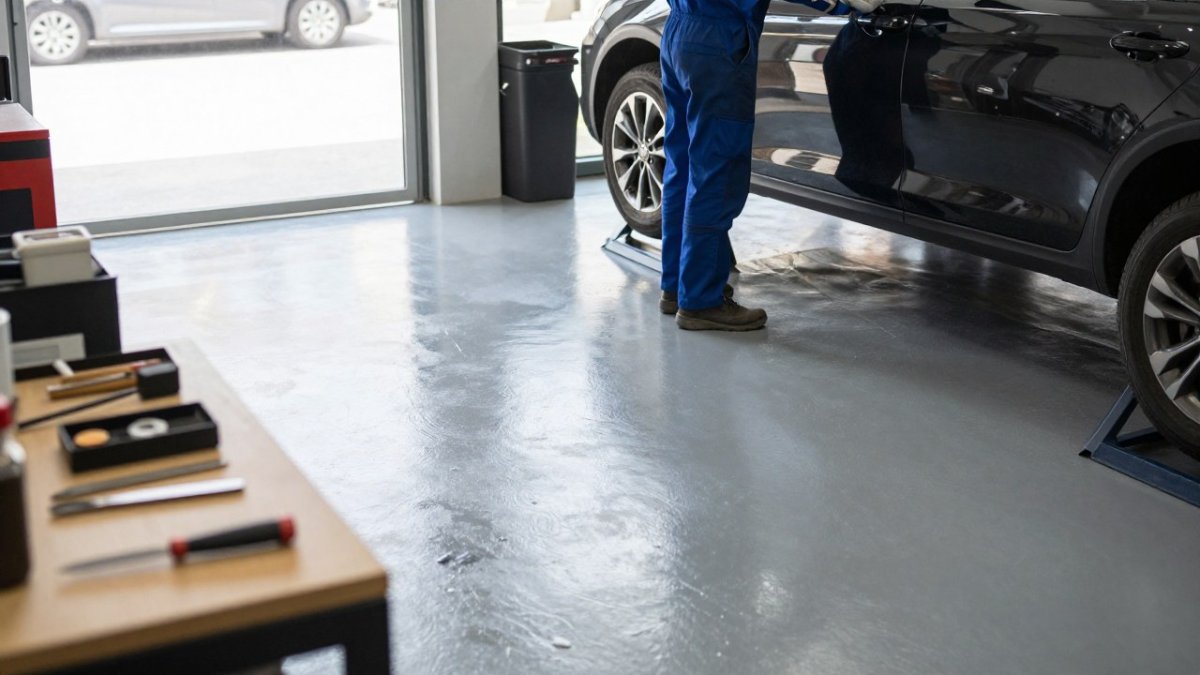
This matters for a workshop because downtime is lost productivity. If you run a small business from the garage, a faster return to service can be the deciding factor. Plan for the manufacturer’s stated cure window rather than a fixed number, since temperature changes the timeline considerably.
Watch out: driving a vehicle onto a coating before the stated cure window can leave tyre marks or imprints that do not fully recover. Confirm the cure schedule with your installer before you schedule vehicle access.
Chemical, Oil and Spill Resistance: Epoxy Holds Its Own
Epoxy is commonly used in workshops, and its chemical resistance depends on the specific formulation and on fully curing the coating. Spills should be cleaned promptly, and the manufacturer’s chemical resistance chart should be checked against the substances you use.
Polyaspartic chemical resistance varies by formulation, so check the manufacturer’s chemical resistance chart for the substances you use. The practical difference is less about which resin is ‘better’ and more about the specific product: chemical resistance varies widely between formulations, even within the same resin family. Always check the manufacturer’s chemical resistance chart against the substances you actually use, and note the stated contact time, most charts distinguish between incidental splashes and prolonged immersion.
Where both coatings struggle is with strong solvents (acetone, MEK, xylene, paint thinners), concentrated acids, and hot metal debris that sits on the surface. Prolonged exposure to any of these can stain, soften or lift either coating. A common pattern in workshops is a slow drip under a parts washer or a hydraulic press that goes unnoticed for weeks; by the time it is cleaned, the coating has swollen and the bond to the slab is compromised. Place a drip tray under any persistent leak source rather than relying on the coating alone.
For workshop-specific spill control, the practical rules are the same for both systems: clean spills promptly, avoid leaving solvent-soaked rags on the floor, and re-coat high-exposure zones (under vehicles, around benches, at the parts washer) with a chemical-resistant topcoat if the standard system is not rated for the substances you use. If your workshop handles solvents or concentrated chemicals regularly, ask the installer what chemical-resistant options are available for your use.
Polyaspartic Floor Coating Cost and Lifecycle Value
Upfront price is the easiest number to compare and the least useful one. A workshop floor is an operating asset, and the cost that matters is the total outlay over its service life, including the labour to install it, the downtime while it cures, the cost of repairs, and the interval before it needs recoating. Pricing depends on floor area, slab condition, the coating system chosen and access. For current pricing on your floor area and condition, contact Garage Floor Coatings for a quote tailored to your slab.
Several factors drive the quote more than the resin choice: floor area, slab condition (cracks, contamination, old coatings that must be ground off), the number of coats, whether a moisture barrier or primer is required, decorative flake or aggregate options, and access constraints. A quote that looks cheap often reflects minimal surface preparation, the single biggest cause of premature failure. Ask each provider what preparation method they use (diamond grinding versus acid etching), what film thickness they specify, and what warranty they give in writing.
The lifecycle comparison is where the two systems diverge. Upfront cost, UV behaviour and recoating intervals vary by product and conditions, so compare current quotes against the specific system proposed. Over a ten-year horizon, a floor that avoids one recoating cycle and one round of yellowing-related replacement can close much of the upfront gap, but only if the slab was properly prepared and moisture-tested in the first place. A cheap coating on a wet slab fails early regardless of resin chemistry.
Downtime is the cost most quotes ignore. Return-to-service times depend on the system chosen, temperature and humidity, so confirm the cure schedule with the installer before booking vehicle access. For a workshop that earns revenue from the floor, each day out of service has a real cost, lost jobs, rescheduled bookings, or rented alternative space.
Repair cost is the third leg. Localised damage, a chipped edge, a worn traffic lane, a scratch from a dropped tool, can usually be repaired on either system without recoating the whole floor, but polyaspartic’s fast cure means a repair is back in service sooner. Ask the installer how they handle spot repairs, whether the repair blends visually, and what the minimum call-out is. When comparing quotes, put the upfront figure, the expected recoating interval, the downtime per installation, and the repair approach side by side, that comparison, not the headline price, is what tells you which floor is better value for your workshop.
Polyaspartic Floor Coating Pros and Cons for Home Workshops
Pros of polyaspartic:
- Fast cure, so the floor returns to use sooner
- Strong UV stability, with little yellowing in sunlit spaces
- Good abrasion and impact resistance
- Smooth, seamless finish that is easy to clean
Cons of polyaspartic:
- Higher upfront cost than standard epoxy
- Demands precise application and a short working window
- Requires a well-prepared, moisture-tested slab to perform well
Best for: Home workshops used daily, garages in sunlit spaces, and anyone who needs fast turnaround.
Skip if: Your budget is the main constraint and the floor is strictly indoors.
Slip Resistance, Moisture and Concrete Testing
Slip resistance is a real concern in a damp garage, especially with children around. Slip resistance can be affected by the finish selected. Ask your installer what grip level the finished surface achieves and whether it has been tested under wet conditions.
Moisture is the hidden risk. Rising damp or vapour through an old slab can lift any coating. Moisture and substrate condition should be assessed before installation, and cracks or contamination treated before the coating is applied. Careful substrate preparation is what separates a floor that lasts from one that peels.
Booking Your Workshop Floor Assessment
Choosing between polyaspartic and epoxy comes down to your use, your sun exposure and your timeline. If you are unsure which suits your workshop, the best next step is a site assessment that checks the slab and your requirements together. Visit the polyaspartic flooring page to see what the service covers, or compare the epoxy resin floor option for an indoor-focused build. For a detailed look at downtime, read our full cure-time breakdown. When you are ready to arrange a floor assessment, contact our team to discuss your workshop and get a tailored quote. Garage Floor Coatings can help you choose the system that fits your space.
Frequently Asked Questions
Is polyaspartic coating better than epoxy for a workshop?
For many home and light commercial workshops, polyaspartic can be a suitable choice when speed and UV stability matter. Cure times and UV behaviour depend on the specific product, so confirm them with the installer. Epoxy can still suit a workshop that is mainly used indoors. Neither coating is universally better; the right pick depends on how the space is used, how much downtime you can tolerate and your budget.
What is the difference between polyaspartic and epoxy floor coatings?
Both are resin-based coatings applied over prepared concrete, but they cure differently. Epoxy hardens through a reaction that takes longer, often days before heavy use, and it can yellow under UV exposure. Polyaspartic cures much faster, typically within hours for light traffic, and it stays clearer in sunlight. Pricing and performance vary by product and installation, so compare current quotes for the specific system proposed.
How long does polyaspartic floor coating take to cure compared with epoxy?
Cure times depend on the specific product, temperature and humidity. Confirm the manufacturer’s stated cure window with the installer before scheduling vehicle access. Always check the product data sheet for the specific system, as cure times vary by brand and conditions.
Which workshop floor coating handles chemicals and oil better?
Chemical resistance depends on the specific product formulation and on the substances involved, so check the manufacturer’s chemical resistance chart against the substances you use. Wipe up spills promptly whichever coating you choose, and confirm the chemical rating for the specific product with your installer before committing.
