Table of Contents
- Why Food Plant Floors Fail Prematurely
- Durable Floor Coatings for Food Plants: The Core Options
- HACCP Compliant Flooring Requirements Explained
- What a Food Grade Flooring Cost per Meter Review Reveals
- Slip Resistance and Thermal Shock: Design for Real Conditions
- Substrate Preparation: The Non-Negotiable First Step
- Lifecycle Cost Analysis: Cheap Flooring Costs More
- Conclusion: Specifying a Floor That Passes Audits for Decades
- Frequently Asked Questions
Last Updated: September 8, 2026
Why Food Plant Floors Fail Prematurely
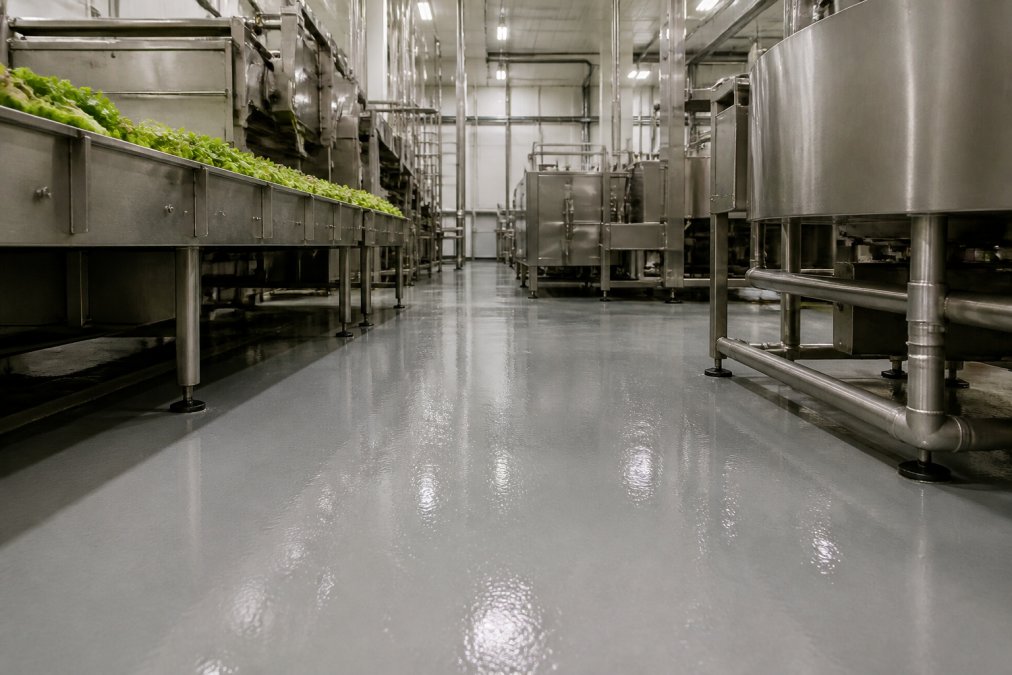
Most food plant flooring failures are not material failures. They are specification failures. The coating itself rarely gives out first; instead, it was never suitable for the thermal, chemical, or mechanical loads the facility actually generates. Understanding this distinction is the first step toward a floor that survives a decade of audits and washdowns.
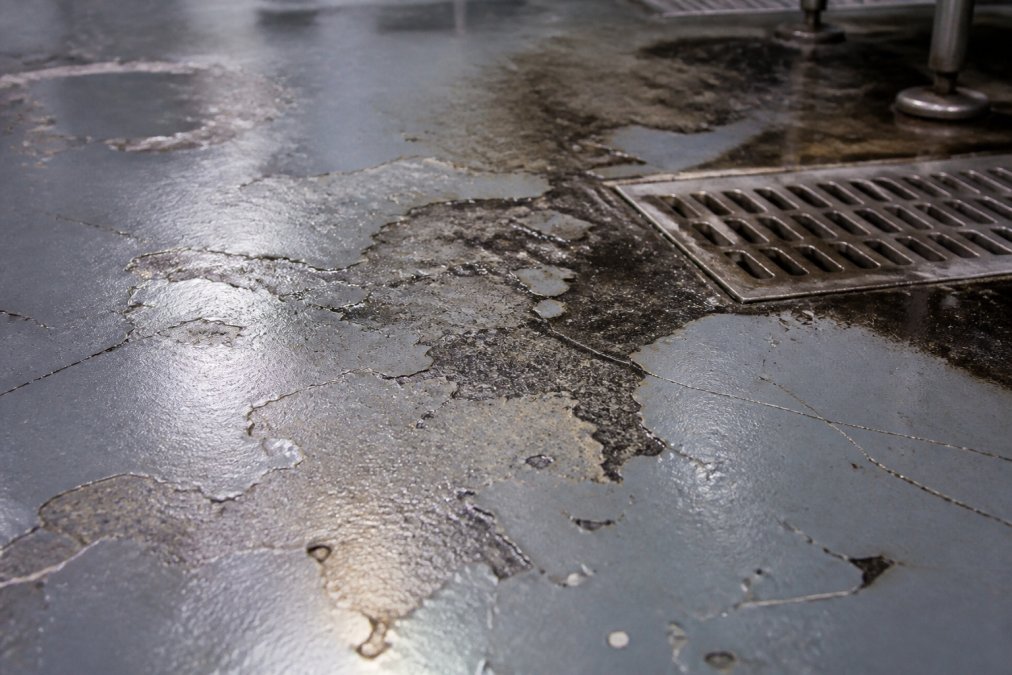
The typical failure sequence follows a predictable pattern. Hot water and caustic cleaning agents attack the binder system, causing micro-cracks (peer-reviewed research). These cracks admit moisture and bacteria, which then undermine the bond to the concrete substrate. Within a few years, the coating delaminates in patches, creating exactly the harborage points that food safety auditors look for.
At Garage Floor Coatings, we have over 20 years of industry expertise in transforming ordinary concrete into extraordinary, high-performance surfaces. The overwhelming majority of premature failures trace back to three root causes: inadequate substrate preparation, a mismatch between the resin chemistry and the operating environment, and poor drainage detailing around floor drains and coving. Each of these is preventable at the specification stage.
Durable Floor Coatings for Food Plants: The Core Options
Selecting durable floor coatings for food plants requires matching the resin system to the specific processing environment. Three polymer families dominate the sector, and each has a distinct performance profile that suits different zones within a facility.
Polyurethane cement systems are the workhorse of food processing. They combine the flexibility of polyurethane with the compressive strength of cement, delivering outstanding thermal shock resistance. Epoxy systems offer excellent chemical resistance and are typically more economical, but they tend to be more brittle under thermal cycling. Methyl methacrylate (MMA) systems cure rapidly and can return a floor to service within hours, which suits facilities with tight production windows.
For most facilities, the decision is not about finding a single “best” material. It is about zoning the plant and specifying the correct system for each area’s exposure profile. A loading dock, a cooking line, and a cold storage room each demand different performance characteristics.
Polyurethane Cement vs Epoxy for Food Plants
When comparing polyurethane cement vs epoxy for food plants, the decisive factor is thermal performance. Polyurethane cement handles the rapid temperature swings of hot washdown cycles without cracking, while standard epoxy can fail under the same conditions.
| Property | Polyurethane Cement | Epoxy |
|---|---|---|
| Thermal shock resistance | Excellent | Moderate |
| Chemical resistance | Good | Excellent |
| Flexibility | High | Low |
| Installation cost | Higher | Lower |
| Best for | Cooking lines, washdown zones | Dry storage, packaging areas |
Epoxy remains a strong choice for areas with heavy chemical exposure but minimal thermal stress. The cost difference is real, yet it must be weighed against the cost of a failed floor and the associated production downtime.
Methyl Methacrylate (MMA) for Rapid Return to Service
Methyl methacrylate systems solve a specific problem: time. An MMA floor can be installed and cured within one to two hours, allowing production to resume the same day. This makes MMA ideal for emergency repairs, weekend maintenance windows, or areas where extended downtime is unacceptable.
The trade-off is a sharp odour during installation and a higher material cost. Ventilation requirements are significant, and the installer must manage the fast cure time precisely. For planned shutdowns, polyurethane cement often provides better long-term value; for unplanned failures, MMA is the pragmatic choice.
HACCP Compliant Flooring Requirements Explained
HACCP compliant flooring requirements centre on a single principle: the floor must not become a source of contamination. This means the surface must be seamless, non-porous, and capable of withstanding the sanitation chemicals used in the facility. The Hazard Analysis and Critical Control Points framework is a preventive food safety system, not a flooring standard itself, so compliance is demonstrated by meeting the hygiene criteria that HACCP plans rely upon.
The practical requirements translate into specific design features. Floors must have coving at wall junctions to eliminate horizontal ledges where debris and bacteria accumulate. Drains must be integrated flush with the floor surface, and the finish must resist bacterial growth through its non-porous nature rather than relying solely on anti-microbial additives.
A compliant floor must also be verifiably cleanable. This means the surface finish must survive the facility’s documented washdown procedures, including the specific chemical concentrations and water temperatures used. A floor that degrades under cleaning agents fails the core HACCP requirement, regardless of its initial appearance.
What a Food Grade Flooring Cost per Meter Review Reveals
A food grade flooring cost per meter review reveals a common misunderstanding: the cheapest system per square metre is almost never the most economical over the floor’s service life. The cost of a food plant floor is dominated by installation labour, substrate preparation, and production downtime, not the raw material price.
Material costs vary substantially between systems. Standard epoxy is generally the least expensive, polyurethane cement sits at a moderate premium, and MMA carries a higher cost per square metre. However, installation labour is a significant component across all systems, and the substrate preparation cost is largely identical regardless of the chosen resin.
The critical insight from any honest cost review is that the floor’s total cost of ownership depends on its lifespan. A floor that fails after five years and requires a full re-installation is more expensive than a premium system that lasts fifteen years. The cost per year of service is the metric that matters, not the cost per square metre.
Slip Resistance and Thermal Shock: Design for Real Conditions
Slip resistance is a safety feature, not an optional extra. A food plant floor is frequently wet, often soapy, and occasionally covered in food residue. The slip coefficient of the finished surface must be specified for these conditions, and it must be maintained after years of chemical exposure and wear.
The design approach involves adding aggregate or texture to the top coat to achieve a measured slip coefficient. The correct level depends on the zone: areas where staff walk frequently require a different finish than areas where fork lifts operate. Over-specifying slip resistance can create a surface that is difficult to clean, so the balance requires careful consideration.
Thermal shock resistance is the other critical design factor. Hot cooking oil, boiling water, and steam cleaning all subject the floor to rapid temperature changes. A rigid system like standard epoxy can develop micro-cracks under these conditions, whereas a flexible system such as polyurethane cement absorbs the expansion and contraction without damage.
Substrate Preparation: The Non-Negotiable First Step
Substrate preparation is the single most important factor in the longevity of any resin floor. The coating is only as strong as its bond to the concrete, and that bond depends entirely on the condition of the surface beneath it. No amount of premium material can compensate for a poorly prepared substrate.
The preparation process is mechanical and thorough. Concrete must be shot-blasted or ground to remove laitance and expose a clean, open-pored surface. Cracks must be chased out and repaired with a suitable filler. The moisture content of the concrete must be tested, because excessive moisture vapour transmission will cause any impermeable coating to blister and delaminate from below (concrete.org).
A common mistake is to underestimate the time and cost of preparation. A facility that budgets only for the coating material will be surprised by the preparation work required. This step is not optional, and cutting corners here is the most reliable way to guarantee a premature failure.
Lifecycle Cost Analysis: Cheap Flooring Costs More
A lifecycle cost analysis of food plant flooring consistently shows that the initial purchase price is a poor predictor of total cost. The true cost includes installation, downtime, maintenance, repairs, and the eventual replacement of the floor. When these factors are included, premium systems often deliver a lower total cost of ownership. This section moves beyond the general principle to provide a practical framework for evaluating the true cost of a floor over a 15-year service life.
The Total Cost of Ownership (TCO) Framework
To accurately compare flooring systems, you must move beyond the cost per square metre and calculate the Total Cost of Ownership (TCO). This involves projecting all costs over the expected service life of the floor. A simplified TCO model includes the following components:
- Initial Installation Cost: This includes material, labour, and substrate preparation. It is the only cost most buyers consider.
- Operational Downtime: The cost of lost production during installation and any future repairs. For a food plant, this can be the single largest cost factor, especially if production must halt for an extended period.
- Maintenance and Repair: The annual cost of cleaning chemicals, routine maintenance, and minor repairs. A more durable floor will have lower annual maintenance costs.
- Replacement Cost: The cost of removing and reinstalling the floor at the end of its service life. This is a major expense that is often overlooked.
A Comparative Example: Epoxy vs. Polyurethane Cement
Let’s consider a 1,000 m² processing area with a 15-year planning horizon. The figures below are indicative and based on typical industry ranges for a high-traffic, washdown environment. They are intended to illustrate the calculation method, not to provide a quote.
| Cost Component | Standard Epoxy (5-yr life) | Polyurethane Cement (15-yr life) |
|---|---|---|
| Initial Installation | $150/m² | $250/m² |
| Installation Downtime | $50,000 (1 week) | $50,000 (1 week) |
| Annual Maintenance | $5,000/yr | $2,000/yr |
| Repairs (Year 3) | $15,000 | $0 |
| Full Replacement (Year 5) | $200,000 (incl. downtime) | $0 |
| Total Cost (15 Years) | $150,000 + $50,000 + $75,000 + $15,000 + $200,000 = $490,000 | $250,000 + $50,000 + $30,000 = $330,000 |
In this scenario, the polyurethane cement floor, despite a 67% higher initial material cost, delivers a 33% lower total cost of ownership over 15 years. The savings come from avoiding a full replacement and its associated downtime.
The Hidden Cost of Failure
The analysis must also account for the cost of failure. A floor that fails in a food plant does not merely require repair; it may trigger a non-conformance finding during an audit, leading to production stoppages and lost product. A single day of lost production can easily cost more than the entire flooring installation. These indirect costs can dwarf the direct cost of the flooring itself.
For this reason, the specification should be driven by the required service life and the cost of downtime, not by the material price per square metre. Facilities that adopt this approach typically select polyurethane cement for high-risk zones and reserve lower-cost systems for areas with minimal exposure.
By using a TCO model, you can make a data-driven decision that protects your facility’s bottom line and ensures your floor remains a hygienic, safe, and productive asset for decades.
Conclusion: Specifying a Floor That Passes Audits for Decades
Specifying floor coatings for food plants is an exercise in risk management. The floor must withstand thermal shock, chemical attack, and heavy traffic while remaining cleanable and compliant. The systems that achieve this are not the cheapest per square metre, but they are the most economical over their service life.
The decision framework is straightforward. Assess the thermal and chemical exposure in each zone, specify the resin system accordingly, and invest properly in substrate preparation. Engage a specialist who understands both the materials and the regulatory environment. The guidance from food safety bodies reinforces that hygienic design is a preventive measure, not a reactive one Food Standards Australia New Zealand guidance on food premises.
Garage Floor Coatings brings over two decades of experience to industrial resin flooring, using materials such as epoxy, polyurethane, and flake systems to deliver durable, stylish, and functional flooring solutions. Our meticulous attention to detail ensures a seamless experience from initial consultation to the final finish, providing you with a floor that stands the test of time.
Get started with Garage Floor Coatings and specify a floor that passes audits for decades.
Frequently Asked Questions
What is the most durable floor coating for a food plant?
Polyurethane cement is the most durable option for wet processing areas. It handles thermal shock from hot water washdowns, resists a wide pH range of chemicals, and absorbs impact without cracking. Standard epoxy is harder but more brittle and will fail faster under temperature swings. For dry areas like packaging rooms, a heavy-duty epoxy can be suitable, but polyurethane cement is the benchmark for durable floor coatings for food plants.
What are the mandatory hygiene standards for food processing floors?
In Australia, floors must meet the Food Standards Code and be suitable for the activity. For export facilities, AQIS and the relevant export standards apply. Practically, this means a seamless, non-porous surface with coving at walls and drains to prevent bacterial growth. While HACCP is a food safety management system, auditors require flooring that is easy to clean, resistant to chemicals, and free from cracks where bacteria can harbour.
Why is polyurethane cement preferred over standard epoxy in food plants?
Standard epoxy struggles with thermal shock. When you hit a rigid epoxy floor with 80°C washdown water, the rapid temperature change causes it to delaminate. Polyurethane cement is flexible enough to absorb that stress. It is also more tolerant of steam cleaning and has better resistance to the organic acids found in food processing. For durable floor coatings for food plants, polyurethane cement offers a longer service life in wet areas.
What is the expected lifespan of industrial food-grade floor coatings?
A properly installed polyurethane cement system typically lasts 10 to 15 years, even with daily caustic washdowns. A standard epoxy, by contrast, might last 3 to 5 years in the same environment before it starts to blister or lose its bond. The lifespan depends heavily on substrate preparation. A floor installed over a poorly prepared slab will fail early regardless of the material used.
How do you maintain slip resistance in wet food processing environments?
Slip resistance is engineered into the floor, not added later. The coating should include an aggregate broadcast into the top coat to achieve a specific slip coefficient. For wet areas, you need a coarser profile than you would in a dry warehouse. The texture must be tight enough to clean easily but aggressive enough to prevent slips. Regular cleaning with the correct chemicals prevents a build-up of fats that can make any floor slippery.