
Table of Contents
- Epoxy Floor Cost in 2026: What Drives the Price
- Factors Affecting Epoxy Floor Installation Price
- DIY vs Professional Epoxy Garage Floor Cost
- How Much Downtime for Garage Flooring?
- Long-Term Value: Maintenance, ROI and Property Impact
- Choosing the Right Epoxy Floor Cost for Your Garage
- Frequently Asked Questions
Last Updated: September 12, 2026
Epoxy Floor Cost in 2026: What Drives the Price
Working out the cost of epoxy garage floor 2026 pricing starts with one fact: there is no single rate. A garage floor coating is a system, not a product, and the price reflects what goes into preparing and sealing your specific slab. At Garage Floor Coatings, we’ve spent over two decades quoting and installing these systems, and the variables that move the number most are surface condition, floor area, and coating type.
Epoxy garage floor cost is the total price of preparing a concrete slab and applying a resin-based coating system to it, covering labour, materials, and surface preparation. Most quotes differ because contractors assess substrate condition differently.
A standard coating typically includes:
- Diamond grinding or acid etching of the concrete
- Crack repair and patching
- A primer coat
- A base coat with colour or flake
- A protective top coat
Safe Work Australia’s guidance on construction site hazards sets the safety framework contractors work within during surface preparation.
What a Standard Garage Floor Coating Includes
A complete system covers preparation, repair, priming, base coating, and sealing. Skipping any stage shortens the floor’s life.
The primer coat bonds the coating to the slab. The base coat delivers colour and build thickness. The top coat provides abrasion resistance, chemical resistance, and UV stability.
Factors Affecting Epoxy Floor Installation Price
Factors affecting epoxy floor installation price come down to four things: slab size, substrate condition, coating system chosen, and site access. Two garages of identical size can quote very differently if one has moisture issues and the other doesn’t. Understanding the mechanism behind each factor is what lets you read a quote properly instead of just comparing headline numbers.
| Factor | Why It Changes the Price | Typical Impact |
|---|---|---|
| Floor area | Priced per square metre; larger slabs spread fixed costs but consume more resin | Largest single driver |
| Substrate condition | Cracks, spalling, contamination, and old coatings add labour and materials | Moderate to high |
| Coating system | Solid, flake, or metallic; build thickness and top-coat type | Moderate |
| Moisture barrier | Required on damp slabs; two-coat epoxy or specialist membrane | Moderate |
| Site access | Stairs, tight entries, clearing, and parking for equipment | Low to moderate |
Floor Area and How It Is Priced
Almost every installer prices per square metre, but the rate is not linear. A single garage of roughly 18 to 20 square metres and a double of roughly 36 to 40 square metres share the same fixed costs: mobilisation, equipment setup, and a minimum materials order. That means the per-square-metre rate on a double garage is usually lower than on a single, even though the total is higher. Ask for both the rate and the total so you can see which fixed costs are being spread.
Substrate Condition: The Variable That Moves Most
A sound, dry, uncontaminated slab needs grinding and a primer. A slab with hairline cracks, spalling, or old sealer needs additional work before any coating goes down. Common add-ons include:
- Crack stitching and filling for structural cracks
- Spall repair using a cementitious patching compound
- Grinding or shot-blasting to remove old coatings, glue, or contamination
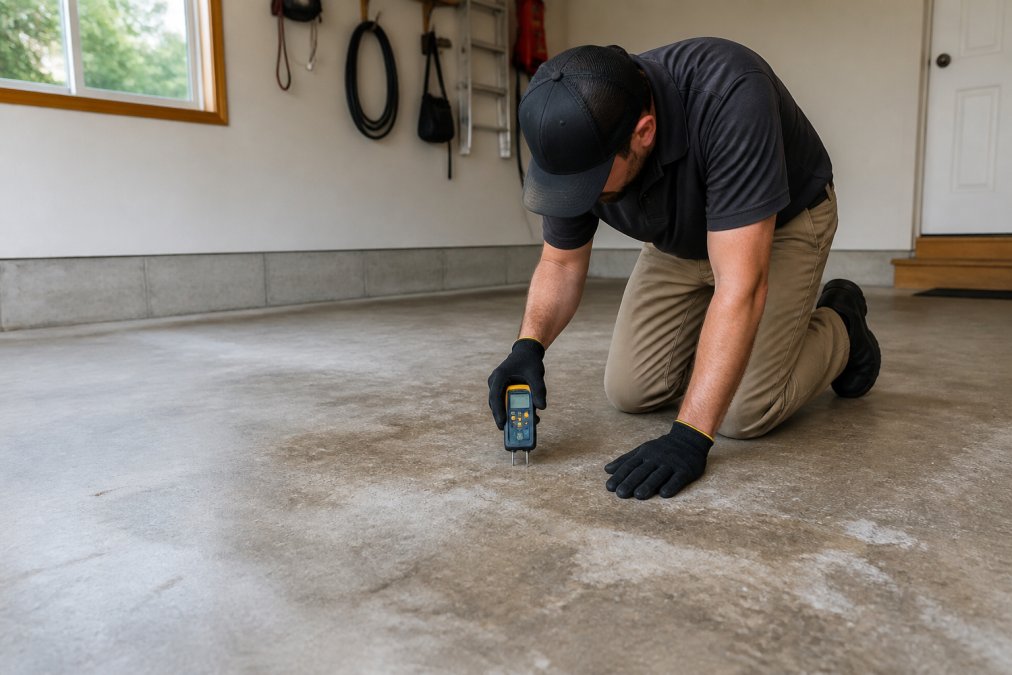
- Moisture testing and, if needed, a moisture barrier
Each of these adds labour hours and materials, and each is a legitimate reason for one quote to sit above another. A quote that ignores them is not cheaper; it is incomplete.
Coating System and Build Thickness
A basic solid-colour epoxy is the least expensive system. A full flake broadcast, where vinyl flakes are scattered into the wet base coat and sealed under a clear top coat, uses more material and more labour. Build thickness matters too: a thin roll-coat system costs less than a high-build system, but it wears through faster in a working garage.
Moisture Barrier: The Cost That Prevents a Redo
Where a slab sits below grade or shows elevated moisture, a barrier is not optional. Options include a two-coat epoxy moisture barrier or a specialist membrane, and both add a step and a product line to the quote. Skipping it to save money is the most common false economy in this trade.
Site Access and Preparation Logistics
Access affects how long the crew is on site. A ground-level garage with a clear driveway is straightforward. A basement garage reached by stairs, a tight single-width entry, or a space packed with stored items adds time for carrying equipment in, clearing the floor, and removing grinding dust. These are small line items individually, but they add up.
Concrete Preparation: The Cost You Cannot Skip
Concrete preparation is the stage most DIY kits underplay, and it’s where most failures begin. Surface grinding or acid etching opens the concrete’s pores so the epoxy resin bonds properly. A moisture barrier is essential where slabs sit below grade or show damp.
If preparation is skipped, the coating peels and bubbles within a couple of years. That’s the single most common reason a cheap job becomes an expensive one.
Applying epoxy over a damp or dusty slab without a moisture barrier is the leading cause of coating failure. The floor lifts within months, and you pay twice: once for the failed coat, once for removal and redoing it.
Hidden Costs Most Quotes Leave Out
The cheapest quote often isn’t the cheapest job. Watch for these exclusions:
- Moisture testing and barrier application – frequently omitted
- Crack and spall repair – billed as an extra once work starts
- Furniture and equipment removal – rarely included
- Minimum call-out or service fees – common on small jobs
- Disposal of grinding dust and debris – sometimes added later
Ask every provider to itemise these before you compare numbers. A quote that lists them is easier to trust than one that doesn’t.
DIY vs Professional Epoxy Garage Floor Cost
DIY vs professional epoxy garage floor cost is not as far apart as it looks once you count your own time, tool hire, and the risk of a failed coat. A DIY kit covers materials only. It excludes grinding equipment hire, surface repair, and the cost of redoing the job if the bond fails.
Professional application includes site inspection, preparation equipment, correct product selection for your slab, and a workmanship guarantee. For a full flake system or polyurethane cement build, professional installation is the only realistic route.
When DIY Makes Sense and When It Costs More
DIY can work on a small, dry, sound slab with minor cosmetic wear, where you already own the tools and accept a shorter lifespan.
It stops making sense when:
- The slab is damp or has a moisture problem
- There are structural cracks or spalling
- You want a full flake or metallic finish
- The floor takes heavy vehicle or chemical use
Before choosing DIY, test your slab for moisture. Tape a square of plastic sheet to the concrete, leave it overnight, and check for condensation underneath. If it’s damp, a coating without a moisture barrier will fail regardless of how well you apply it.
How Much Downtime for Garage Flooring?
Downtime for garage flooring depends on the system and the cure schedule. Most residential jobs need the garage clear for two to three days, with foot traffic allowed after the initial cure and vehicle traffic after the full cure.
Curing time varies by product and ambient temperature. Cooler weather extends it. Plan around the schedule your installer gives you, and clear the space fully before work begins.
CSIRO research on coatings and material performance covers how resin systems behave under different conditions.
Long-Term Value: Maintenance, ROI and Property Impact
Most guides stop at the upfront quote. The more useful question is what the floor costs you to own over five to ten years, and what it gives back. That is the Total Cost of Ownership view, and it is where a quality coating separates itself from a cheap one.
Maintenance Cost Over Five to Ten Years
A properly installed epoxy floor needs only sweeping and occasional damp mopping. A poorly bonded floor needs patching, and eventually full removal. The pattern most installers see is:
- Years 1-2: minimal maintenance on a sound system; failed DIY coats start lifting at the edges and around vehicle tyres
- Years 3-5: a quality floor may need a fresh clear top coat in high-traffic zones; a failed floor needs patch repairs
- Years 5-10: a well-built system is still serviceable; a failed one is usually due for full removal and replacement
Removal and replacement is the expensive path. It means grinding off the old coating, re-preparing the slab, and starting again, so the money saved on a cheap initial job is often spent twice over.
What Drives the Difference
Three things determine which path your floor takes:
- Surface preparation quality – the single biggest factor in whether the coating bonds
- Moisture control – a barrier where the slab needs one prevents lifting from below
- Top-coat choice – a UV-stable top coat resists yellowing and wear better than a basic epoxy sealer
A durable floor also resists oil, chemicals, and moisture, which protects the concrete underneath. That protection is the part buyers and inspectors notice.
Property Value and Resale Appeal
Epoxy does not add a fixed dollar figure to a property, and any guide that promises one is guessing. What it does is remove a common objection. A cracked, stained, dusty garage floor reads as a maintenance problem to a buyer. A clean, coated floor reads as a finished, low-effort space. In a market where buyers compare similar homes, that presentation difference can influence how quickly a property moves and how the garage is perceived during inspection.
A Simple TCO Comparison
When you compare quotes, compare them on total cost of ownership rather than headline price:
| Cost Item | Cheap Coating | Quality System |
|---|---|---|
| Upfront installation | Lower | Higher |
| Maintenance over 5-10 years | Patching, spot repairs | Sweeping and damp mopping |
| Risk of full removal | High if preparation was skipped | Low |
| Resale presentation | May look tired | Holds up well |
The cheapest quote is only cheaper if it survives. Price the preparation, the moisture barrier, and the top coat into every comparison, then judge the total over a decade, not a weekend.
Questions to Ask Before You Commit
- What preparation is included, and how will moisture be tested?
- Which top coat is specified, and is it UV-stable?
- What does the workmanship warranty cover, and for how long?
- What is the expected recoat interval for my level of use?
Answers to those four questions tell you more about long-term value than any single price on a quote.
Choosing the Right Epoxy Floor Cost for Your Garage
Choosing the right cost means matching the system to how you actually use the garage, not chasing the lowest quote. A weekend workshop handling oil spills and solvents needs chemical resistance. A showroom needs a visually striking metallic finish. A food-grade space needs a hygienic, seamless, compliant surface.
Request a site inspection, ask for an itemised quote, and confirm what’s covered by warranty. Compare total cost of ownership, not just the headline figure.
At Garage Floor Coatings, we’ve installed epoxy, polyurethane, and flake systems across residential garages, workshops, warehouses, and showrooms for over two decades. Our process runs from initial consultation to the final finish, with materials chosen for your slab and your use.
Standards Australia on flooring and coating standards outlines the benchmarks reputable installers work to.
Frequently Asked Questions
How much does it cost to epoxy a double garage floor in 2026?
Pricing depends on floor size, substrate condition, and the system you choose. A double garage typically needs full flake or solid colour epoxy with primer and top coat, plus grinding and crack repair. Because rates vary by preparation depth and material quality, request a site inspection and written quote to get an accurate figure for your garage.
What factors influence the price per square metre for epoxy flooring?
Key factors include concrete preparation method (surface grinding vs acid etching), moisture barrier requirements, coating thickness, and the type of system selected. Substrate condition, such as cracks or oil contamination, adds labour. Access, curing time, and whether you choose a full flake system or solid colour coating also shift the final rate.
Is epoxy flooring a cost-effective long-term solution for garages?
A professionally applied epoxy floor resists abrasion, chemicals, and moisture, which reduces repair and replacement costs over time. Maintenance is typically simple sweeping and occasional pH-neutral cleaning. Compared with bare concrete that stains and dusts, a properly installed coating protects the slab and can improve the appearance and usability of the space for many years.
What are the hidden costs of DIY versus professional epoxy installation?
DIY kits often omit surface grinding, moisture testing, and primer coats, which leads to peeling or bubbling. Renting a grinder, buying repair materials, and disposing of waste can add up. Professional installation includes site inspection, correct preparation, and a warranty. Ask for a detailed quote that lists preparation, materials, and labour so you can compare fairly.
A garage floor is a long-term decision, and the wrong coating costs more to fix than to install correctly the first time. Garage Floor Coatings brings over 20 years of experience, tailored epoxy, polyurethane, and flake systems, and meticulous surface preparation to every job. Get started with Garage Floor Coatings and a floor built to last.