Last Updated: October 23, 2026
Quick Summary
Epoxy flooring protects concrete from gym equipment by sealing the slab against abrasion, dust, sweat and chemical spills, but it does not absorb impact. A coated slab resists wear and cleans easily, yet it will not cushion a dropped dumbbell. For impact, you need a mat under the rack and the weights.
- Epoxy is a thin, hard coating bonded to the slab; rubber flooring is a thick, compressible layer laid on top.
- Fit rubber or plastic feet pads under racks and machines to spread load and stop abrasion.
- Epoxy alone is the wrong floor for any training that involves dropping weights.
- The best home gym floor is a sealed concrete base with rubber mats in the lifting zones.
- Moisture is the number one reason coatings fail, so test the slab before installation.
Table of Contents
- Does Epoxy Flooring Protect Concrete From Gym Equipment?
- Epoxy vs Rubber Gym Flooring: How the Two Actually Differ
- Protecting Concrete From Dropped Weights: What a Coating Can and Cannot Do
- The Best Flooring for a Home Gym on Concrete
- Rubber Gym Mats for Concrete Floors: Where They Beat a Coating
- Moisture, Sweat and Chemical Spills: The Failure Points to Watch
- Cleaning, Maintenance and Long-Term Repairability
- Conclusion
- Frequently Asked Questions
Does Epoxy Flooring Protect Concrete From Gym Equipment?
Epoxy flooring protects concrete from gym equipment by sealing the slab against abrasion, dust, sweat and chemical spills, but it does not absorb impact.
Epoxy flooring is a resin-based coating applied over prepared concrete to form a hard, seamless surface.
The practical answer has two parts: for sliding, scraping and staining, a coating does the job; for impact, you need a mat under the rack and the weights.
Epoxy vs Rubber Gym Flooring: How the Two Actually Differ
These are different products solving different problems. Epoxy is a thin, hard coating bonded to the slab; rubber flooring is a thick, compressible layer laid on top. One protects the concrete surface, the other protects what lands on it.
| Feature | Epoxy coating | Rubber gym flooring |
|---|---|---|
| Thickness | Thin film bonded to slab | Thick, compressible layer |
| Impact absorption | Minimal | High |
| Abrasion and stain resistance | High | Moderate |
| Cleaning | Sweep and mop | Lift and clean underneath |
| Equipment stability | Excellent, firm base | Good, can compress under load |
| Best for | Sealing and protecting the slab | Cushioning drops and noise |
For anyone weighing other concrete finishes, polished concrete is worth a look as a third option. It delivers a similar hard, sealed surface without a resin coating.
A coating and a mat are not competitors. The strongest home gym floors use a sealed slab with rubber in the impact zones.
Protecting Concrete From Dropped Weights: What a Coating Can and Cannot Do
A coating handles abrasion well and impact poorly. Dragging a bench, sliding plates and scuffing shoes wear the surface, and a cured coating takes that punishment while keeping the concrete beneath intact.
Concrete is strong in compression and weak in tension. A heavy point load landing on a small area sends a shockwave through the slab, and the damage appears underneath, out of sight.
The useful distinction is between static loads and dynamic loads, because they stress the slab in completely different ways.
Static Loads: Racks, Benches and Machines
A loaded power rack, bench press station or leg press sits on the slab through a handful of small feet, a static point load. Epoxy copes well because the force is steady and spread across the contact patches; the coating is compressed, not struck. Still, a heavy rack on a thin residential slab can crush the coating at the feet over time, and unprotected feet can grind grit into the surface when the rack shifts.
Practical measures that work:
- Fit rubber or plastic feet pads under racks and machines to spread the load and stop metal-on-coating abrasion.
- Keep heavy static equipment off the edges and joints of the slab where support is weakest.
- Check that the slab is thick enough for the equipment, a structural engineer can confirm this if you are unsure, and it is cheaper than repairing a cracked slab.
Dynamic Loads: Dropped Dumbbells, Barbells and Plates
A dropped dumbbell, a missed clean or a barbell dumped from overhead is a dynamic point load. The force is delivered in milliseconds through a tiny contact area, and the slab has to absorb it. Epoxy adds nothing to that absorption, it is a hard film measured in fractions of a millimetre, not a cushion. Its job is to stay bonded while the concrete beneath takes the strain.
What actually happens under repeated drops:
- Hairline cracking: the concrete cracks below the coating, and the crack telegraphs through the finish months later.
- Hollow spots and delamination: the shockwave can break the bond between coating and slab, leaving a hollow-sounding patch that eventually lifts.
- Edge spalling: drops near slab edges or control joints chip the concrete, and the coating chips with it.
Matching Protection to Your Training
The honest answer is that epoxy alone is the wrong floor for any training that involves dropping weights. The table below sets out what each activity actually needs.
| Activity | Typical load pattern | Epoxy alone enough? | What to add |
|---|---|---|---|
| Cardio machines, treadmill, bike | Static, low point load | Yes | Feet pads |
| Bodyweight, yoga, mobility | Minimal | Yes | Nothing |
| Dumbbells set down under control | Moderate dynamic | Usually | Interlocking rubber tiles under the work area |
| Bench press, squat rack | Static plus occasional rerack | Usually | Rubber under the rack and bar path |
| Olympic lifts, deadlifts, cleans | Heavy dynamic, repeated | No | Thick rubber platform or lifting mats |
| Dropped dumbbells from height | Heavy dynamic, concentrated | No | Thick rubber, and accept some slab risk |
Load, Thickness and Damage Thresholds
Three factors decide whether your slab survives a drop: the weight, the contact area and the slab itself. A 20 kg dumbbell landing flat spreads force differently to a loaded barbell hitting on one edge. Thin residential slabs with poor sub-base support crack more readily than thick, well-compacted pours. A coating adds no structural strength to any of this.
There is no universal weight limit to quote, because the outcome depends on slab thickness, sub-base, reinforcement and the contact area of the falling object. Reduce the variables: use mats in the drop zones, keep heavy drops away from slab edges and joints, and have the slab assessed if you plan to lift seriously.
Do not assume a coated floor makes dropped weights safe. Hairline cracks and hollow spots often appear under the coating months later, and repairing them means grinding back the finish.
Epoxy protects concrete from wear, not from impact. If your training involves dropping weights, the coating is the base layer, the mat is the protection.
The Best Flooring for a Home Gym on Concrete
The best flooring for a home gym on concrete is a sealed concrete base with rubber mats in the lifting zones, a surface that resists wear and stains plus cushioning exactly where weights land. If you want the slab itself upgraded, a garage epoxy flooring system gives you the durable base layer to build on. But ‘best’ depends on what you train and how much you want to spend; the framework below compares the four realistic options.
Side-by-Side Decision Framework
| Option | Impact protection | Cleanability | Relative cost | Best for |
|---|---|---|---|---|
| Bare sealed concrete | None, hard surface | Good if sealed; poor if not | Lowest | Cardio, bodyweight, budget builds |
| Epoxy coating alone | None, hard film | Excellent, sweep and mop | Moderate | Cardio, bodyweight, workshops, mixed garages |
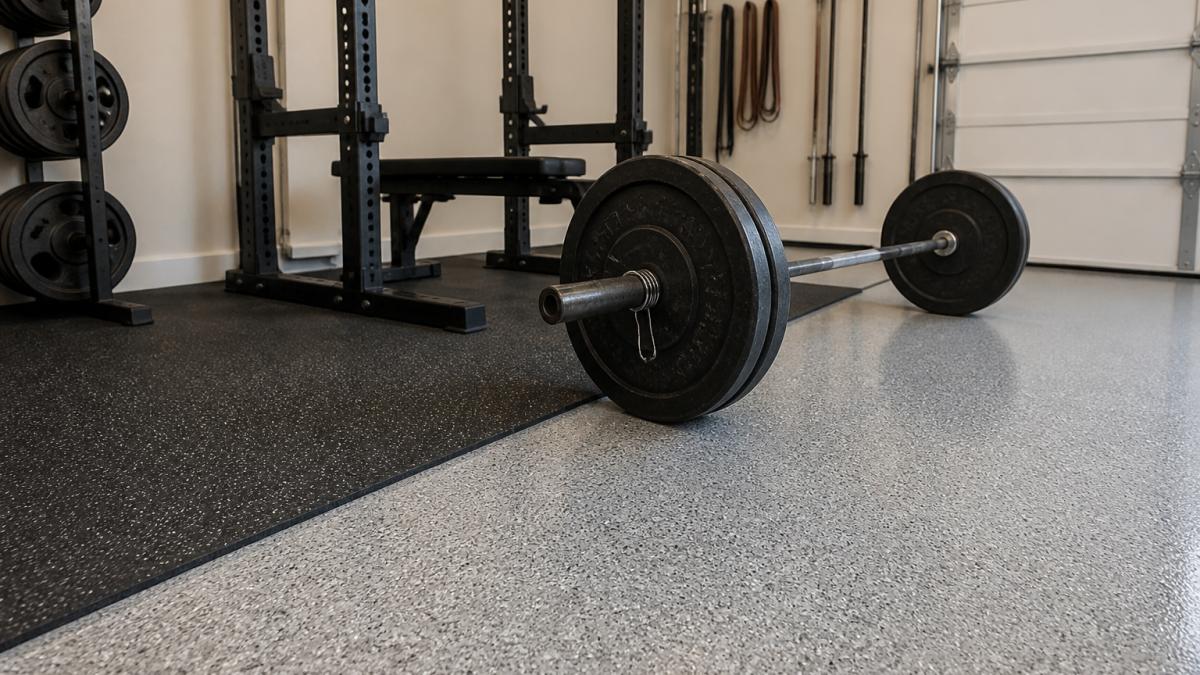
| Epoxy plus rubber mats | High in matted zones | Good, mats lift for cleaning | Moderate to high | Most home gyms, especially free weights |
| Rubber flooring wall to wall | High throughout | Moderate, lifting and cleaning underneath | High | Dedicated lifting spaces, commercial feel |
Cost is relative rather than fixed, depending on area, coating system and mat thickness. A coating is a one-off installation cost across the whole floor, while mats are priced per square metre and can be added incrementally as your setup grows. That is why the coating-plus-mats route suits most home gyms: you coat once, then mat only the zones that need it.
Choosing by Training Type
- Cardio and bodyweight only: a sealed coating is enough on its own. No matting needed.
- Dumbbells up to moderate weight: coating plus interlocking rubber tiles under the work area.
- Barbells, racks and Olympic lifts: coating plus thick rubber, and check your slab thickness first.
That last option is what we recommend most often. You keep a clean, sealed garage and protect the slab where it matters.
Why Not Just Rubber Everywhere?
Wall-to-wall rubber is right for a dedicated lifting space, but it has real costs in a shared garage. It traps moisture under the mats, is heavy and awkward to move for cleaning, and hides the slab so you cannot see a crack or stain developing. A coated floor lets you see the concrete, clean it easily and keep the space usable for parking and storage.
What to Check Before You Commit
- Slab condition: cracks, efflorescence or previous coatings affect what can be installed.
- Moisture: test before coating, see the moisture section below for why this matters.
- Cure time: factor in downtime before you book, our guide to garage flooring cure times explains how long you lose the space.
There is no single best gym floor, only the best match for your training. Coat the slab for protection and cleanability, then mat the zones where weights land.
Rubber Gym Mats for Concrete Floors: Where They Beat a Coating
Rubber gym mats for concrete floors win on impact, noise and grip: they absorb shock, deaden the clang of dropped plates and give surer footing than a hard surface.
Where mats lose: they trap moisture underneath, shift under heavy pushing movements and need lifting to clean. They also do nothing for the concrete’s dust and stain problem outside the matted area.
Put mats under the rack and the free-weight zone, not wall to wall. You get impact protection where it counts and keep the sealed floor easy to clean everywhere else.
Moisture, Sweat and Chemical Spills: The Failure Points to Watch
Moisture is the number one reason coatings fail, and it comes from two directions. Rising damp through the slab pushes against the coating from below. Sweat, spills and cleaning chemicals attack it from above.
Concrete holds residual moisture long after a pour, and a slab with no damp-proof membrane keeps drawing moisture up. Trapped under a coating, that moisture blisters and peels it.
Sweat and oil are less dramatic. A sealed surface wipes clean, and cleaning and sealing guidance keeps it that way. Unsealed concrete drinks oil in and stains permanently.
Cleaning, Maintenance and Long-Term Repairability
Routine care for a coated floor is simple: sweep, mop with a mild cleaner and wipe spills promptly, avoiding harsh solvents that dull the finish. Mats need lifting and cleaning underneath, the hidden labour cost of rubber.
Repairability is where the two diverge. A scuffed coating can often be cleaned or spot-refinished; a deep gouge or crack means grinding back and recoating that area, a job for a professional if you want it to blend. Rubber is easier to replace tile by tile but does nothing for the slab beneath it.
If downtime matters to you, read our guide to garage flooring cure times before booking anything. It explains how long you lose the space.
Conclusion
The real challenge is matching protection to the forces your gym actually produces. Impact and abrasion need different answers, and a floor that ignores one will disappoint within a year.
At Garage Floor Coatings, we build the base layer properly: over 20 years of resurfacing experience, moisture testing before we quote, and epoxy, polyurethane and flake systems tailored to garages, workshops and commercial spaces.
Get started with Garage Floor Coatings and give your concrete a surface that stands up to the training. Call now to arrange an assessment.
Frequently Asked Questions
Does epoxy flooring protect concrete from dropped weights?
Partially, and with limits. Epoxy seals the concrete surface against dust, moisture and routine abrasion, and coating providers describe it as able to withstand dropped weights within reason. That limit is not defined by measured impact testing, so treat epoxy as scratch and wear protection rather than guaranteed impact protection. For heavy deadlifts or Olympic lifts, place rubber mats or drop pads under the bar. If you want a coating specified for your training load, ask a specialist to assess the slab and your equipment before quoting.
Do you need gym mats over an epoxy floor?
Not everywhere, but in the right spots. Epoxy handles foot traffic, general wear and cleaning well, so open floor area rarely needs covering. Put rubber mats or tiles under racks, under free weights and anywhere a barbell gets set down. Rubber gym mats for concrete floors add compression and shock absorption that a thin coating cannot provide, and they protect both the equipment and the coating beneath. This hybrid approach keeps the clean finish visible while shielding the zones that take impact.
Is epoxy or rubber flooring better for a home gym?
They solve different problems. Epoxy vs rubber gym flooring is not a straight contest: epoxy seals the concrete slab, resists oil, sweat and chemical spills, and is easy to sweep and mop, which suits workshops and mixed-use garages. Rubber provides cushioning and impact absorption for weights. Many home gyms combine both, with epoxy across the room and rubber in the lifting zone. Choose based on what your training involves and whether the space doubles as a garage.
Can heavy gym equipment damage epoxy flooring?
It can, particularly through point loads. A rack leg or dumbbell resting on one small contact area concentrates force, and repeated drops can chip or crack the coating. Protecting concrete from dropped weights means spreading that load, which is why rubber tiles under racks are common. A properly prepared slab and a coating applied at the correct thickness reduce the risk, but no coating replaces cushioning. Tell your installer what equipment you use so the system and thickness suit the load.
