Last Updated: October 27, 2026
Quick Summary
Maintaining slip resistant floors in commercial kitchens means cleaning beyond a nightly mop: deep clean grease out of the texture, rinse off detergent residue, and inspect the floor weekly. Fix worn coatings, curled mats and blocked drains while they are small, and record every finding as a task with an owner and date.
- A nightly mop alone loses traction within weeks; deep cleaning pulls grease out of the texture.
- Walk the floor weekly at the same time and in the same order, recording what you find.
- Use the correct detergent dose, rinse after degreasing, then squeegee dry.
- Lift and clean mats daily, and replace rather than patch a curled or torn mat.
- Reopen a cleaned zone only when it is visibly dry and the texture feels grainy.
Table of Contents
- Why Slip-Resistant Floors Lose Grip in a Working Kitchen
- Mistake 1: Cleaning Grease From Kitchen Floors With the Wrong Method
- Mistake 2: Running a Commercial Kitchen Floor Cleaning Schedule That Skips Deep Cleans
- Mistake 3: Letting Detergent Residue and Harsh Chemicals Build Up
- Mistake 4: Ignoring the Commercial Kitchen Floor Inspection Checklist
- Mistake 5: Skipping Commercial Floor Coating Maintenance Until the Floor Fails
- Mistake 6: Wasting Time on Mats, Drainage and Spill Response
- Mistake 7: Leaving Staff Untrained and Maintenance Records Blank
- Frequently Asked Questions
Why Slip-Resistant Floors Lose Grip in a Working Kitchen
A commercial kitchen floor can lose grip as grease, detergent film and worn texture build up. This guide covers seven maintenance mistakes and ways to address them.
The Surface Texture Is the Safety System
Slip resistance is the ability of a floor surface to resist slipping underfoot when it’s wet, greasy or covered in food debris.
Mistake 1: Cleaning Grease From Kitchen Floors With the Wrong Method
If grease has already worked into a worn or porous surface, a deep clean and reseal may be the better fix. You can read about cleaning and sealing options if the floor needs more than a mop.
Mistake 2: Running a Commercial Kitchen Floor Cleaning Schedule That Skips Deep Cleans
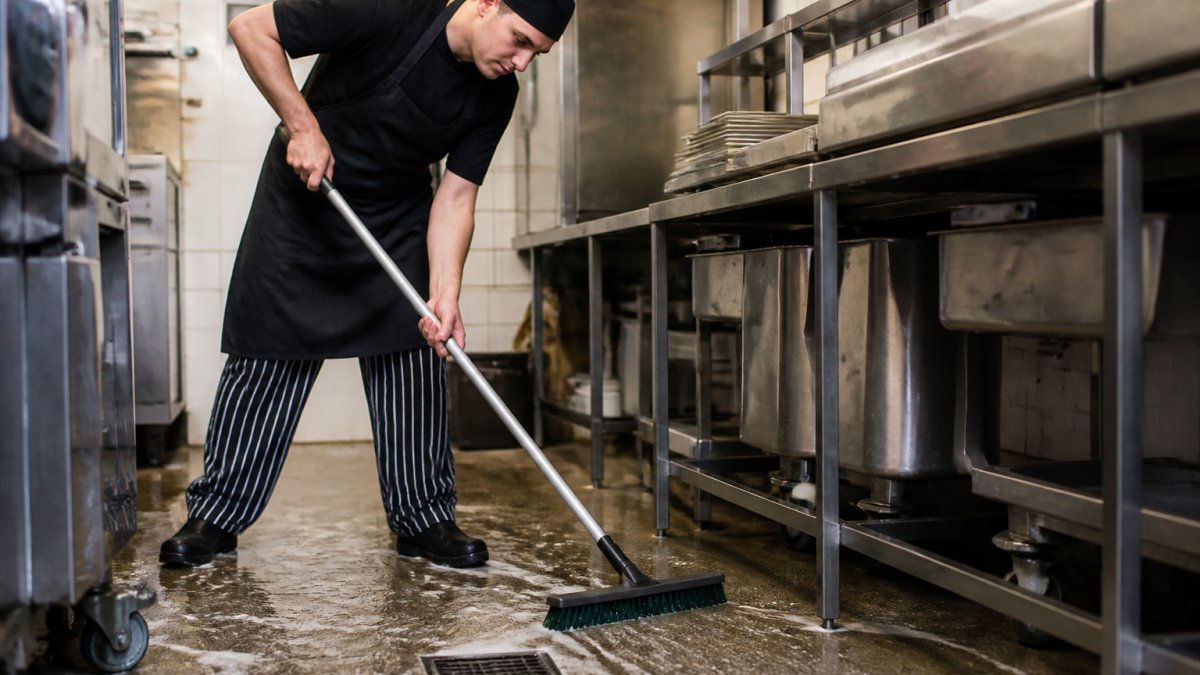
A commercial kitchen floor cleaning schedule that only covers a nightly mop will lose traction within weeks. Daily cleaning lifts surface soil. Deep cleaning is what pulls grease out of the texture.
A Daily, Weekly and Periodic Routine That Actually Works
| Frequency | Task | Purpose |
|---|---|---|
| Every shift | Sweep, spot mop spills, squeegee wet areas | Remove surface soil and standing water |
| Daily close | Hot-water mop with correct dilution, wet-vac up | Lift grease film |
| Weekly | Deck-brush scrub of high-traffic and wet areas | Clear texture valleys |
| Monthly | Deep clean with degreaser, check drains and slopes | Restore grip, clear blockages |
| Quarterly | Slip test and full inspection | Verify performance over time |
Mistake 3: Letting Detergent Residue and Harsh Chemicals Build Up
- Use the correct dose, not a generous splash
- Rinse after degreasing, then squeegee dry
- Match the chemical to the floor type, not to habit
Mistake 4: Ignoring the Commercial Kitchen Floor Inspection Checklist
A commercial kitchen floor inspection checklist turns “it feels slippery” into something you can act on. The point is not to tick boxes, it is to catch the slow decline in texture before a staff member finds it with their feet. Walk the floor weekly at the same time, in the same order, and record what you find.
What to Check, and What Fails
- Texture underfoot in wet areas, run a hand or a soft brush across the surface. If it feels glassy rather than grainy, the valleys are filled or worn.
- Pooling water near drains or low spots, standing water after a wash-down means the slope or drain is failing, not just the mop.
- Cracked, lifted or worn coating patches, any edge where water can get under the coating is a repair job now, not next quarter.
- Grout and joints intact, missing grout holds grease and stops the surface draining.
- Mats flat, clean and not curling, a curled edge is a trip hazard and a trap for grease underneath.
- Drain covers clear and draining freely, a slow drain means standing water somewhere in the kitchen.
- Detergent film or haze, a dull, streaky finish after cleaning usually means residue, not dirt.
How to Verify Slip Resistance Over Time
Researchers have documented how floor slip resistance changes over time in food-sector workshops, where slipping risk runs high (floor slip resistance study). The lesson for a working kitchen is simple: the rating on the day of installation is a starting point, not a guarantee.
Turning the Checklist Into Action
An inspection is only useful if it produces a task. At the end of each walk, sort findings into three buckets: fix now (spills, curled mats, blocked drains), fix this week (worn patches, missing grout, detergent haze), and plan (widespread wear, repeated pooling, a falling slip-test trend). Write the task, the owner and the date against each finding, and review the list at the next walk. That is how a checklist becomes a maintenance system rather than a piece of paper.
Mistake 5: Skipping Commercial Floor Coating Maintenance Until the Floor Fails
Fix damage while it’s small. Clean the area, dry it fully, and patch with a compatible product. If wear is widespread or the surface has gone slick across the whole floor, it’s time to talk about recoating rather than patching. Our services cover repair and reapplication when the coating has reached the end of its life.
Mistake 6: Wasting Time on Mats, Drainage and Spill Response
Mats and drains are part of the safety system, not an afterthought. A curled mat is a trip hazard. A blocked drain means standing water, and standing water is where slip-and-fall risk climbs fastest. Spill response is the third leg: the faster and more completely a spill is removed, the less time the floor spends in its most dangerous state.
Mats: Choose, Place and Clean Them Properly
- Choose a mat with a drainage or scraper face for wet areas, and a backing that grips the floor rather than sliding on it.
- Place mats at the entry to wet zones and in front of sinks and fryers, not in walkways where they bunch and curl.
- Lift and clean mats daily, grease and food collect underneath, and a mat sitting on a greasy film is a slip hazard in itself.
- Replace, do not patch, a mat with a curled edge or a torn corner, a trip hazard is not a maintenance item to defer.
- Never use a mat to cover a floor that has gone slick, fix the floor, then decide whether a mat is still needed.
Drains: Keep Water Moving Off the Floor
Standing water is the clearest sign that drainage is failing. Check drains weekly as part of the floor walk:
- Lift the cover and clear food debris and grease from the basket.
- Check that the drain sits at the low point and that water flows to it rather than pooling nearby.
- Flush with hot water after degreasing to keep grease from setting in the trap.
- If a drain backs up or a low spot holds water after a wash-down, treat it as a repair job, re-grading or re-draining is cheaper than a fall.
Spill Response While the Kitchen Keeps Running
A spill mid-service does not mean stopping the kitchen. It means isolating, cleaning and drying the affected zone while service continues around it.
- Cordon and warn, place a cone or a staff member at the edge of the spill, and tell the team which route to use.
- Absorb the bulk, use a spill kit or absorbent granules, not a mop, which spreads grease across a wider area.
- Degrease, scrub and rinse, apply the correct dilution of degreaser, work it into the texture with a brush, and rinse thoroughly.
- Remove the dirty water, squeegee or wet-vac it up rather than letting it dry on the floor.
- Dry fully before reopening, a damp floor is still a slip risk. Dry the zone, then remove the cordon.
Reopening Criteria
A zone is safe to reopen when it is visibly dry, the texture feels grainy underfoot, and no residue or detergent film remains. If the floor still feels slick after cleaning and drying, do not reopen it, deep clean again, retest, and if it does not recover, take it out of use and inspect for worn texture. A short closure is cheaper than an injury.
Mistake 7: Leaving Staff Untrained and Maintenance Records Blank
Contact us to talk through your kitchen.
Frequently Asked Questions
How often should commercial kitchen floors be cleaned?
Sweep and spot-mop throughout service, then mop the full floor with a degreasing detergent at the end of every shift. Schedule a deeper clean weekly for grout lines, corners and under equipment, and a periodic machine scrub or steam clean monthly depending on grease load. Grease builds in the surface texture faster than most crews expect, and once it cures it reduces slip resistance until it is physically removed. Record each clean so you can prove the routine is being followed during a food safety audit.
What is the best way to clean a slip-resistant kitchen floor?
Remove dry soil first, then apply a degreaser matched to the soil and let it dwell for the manufacturer’s stated time. Agitate with a deck brush or a low-speed scrubber so the bristles reach into the surface texture, then recover the dirty water with a wet vacuum or squeegee rather than pushing it around. Rinse with clean water and let the floor dry fully. Never leave detergent residue behind: it forms a film that is slicker than the grease you removed. Cleaning grease from kitchen floors is a dwell-and-agitate job, not a stronger-chemical job.
Can harsh chemicals damage a slip-resistant floor coating?
Yes. Strong caustic degreasers, undiluted bleach and acid-based descalers can attack the resin binder in a coated floor and dull the aggregate that provides grip. Over time the surface becomes smoother and slip ratings drop. Dilute chemicals to the manufacturer’s ratio, keep contact time within the label, and rinse thoroughly. Check chemical resistance before introducing a new product, and note that AS 4586 slip classifications only describe the floor as tested, not how it performs after years of aggressive cleaning.
When should a commercial kitchen floor be resealed or recoated?
Act when the inspection checklist shows worn texture in traffic lanes, chipped or lifting coating, or a floor that stays slippery after a proper deep clean. Small worn patches can often be recoated before water reaches the concrete underneath. If the substrate is exposed or the floor fails a slip test in wet conditions, plan a full recoat. Build this into your commercial floor coating maintenance budget so it is a scheduled cost rather than an emergency closure during service.
The floor you walk on during service is the same floor your staff and customers trust to keep them upright. If your coating is worn, slick or past patching, Garage Floor Coatings can help. We bring over 20 years of experience, high-performance epoxy and polyurethane systems, and non-slip, easy-to-clean finishes built for food safety standards. Get started with Garage Floor Coatings and give your kitchen a floor that holds its grip.
