Quick Summary
The best garage floor coating for cold climates is usually polyaspartic, because it cures fast and tolerates lower application temperatures than epoxy. Polyurea is the strongest choice where road salt and slab movement are heavy, while epoxy suits dry, lightly used garages on a budget.
- Polyaspartic often cures faster and tolerates lower application temperatures than epoxy.
- Polyurea offers excellent flexibility and is generally regarded as resistant to road salt.
- Standard epoxy can become brittle in low temperatures and is weakest under heavy salt exposure.
- Check slab temperature, not just air temperature, against the product’s minimum before installing.
- Postpone installation if the slab sits within about 3°C of the dew point.
Table of Contents
- Why Cold Climates Are Hard on Garage Floors
- Comparing Epoxy, Polyaspartic, Polyurea and Polyurethane Coatings
- Garage Floor Coating Temperature Requirements for Installation
- Epoxy Garage Floor Coating in Cold Weather: What to Expect
- Garage Floor Coating Cure Time in Cold Weather
- Road Salt Resistant Garage Floor Coating and Freeze-Thaw Exposure
- Preparing Your Garage Floor for a Winter Coating
- Booking Your Cold-Climate Garage Floor Coating
- Frequently Asked Questions
Why Cold Climates Are Hard on Garage Floors
Last Updated: October 29, 2026
Cold weather stresses a garage floor in ways most coatings were never designed for.
Concrete is porous. Water seeps into cracks, freezes, expands, and shifts the slab, pushing against the coating’s bond.
Road salt and de-icing chemicals add a second problem.
Temperature matters during installation as well as afterwards.
The practical takeaway: a cold-climate garage needs a coating that tolerates movement, resists salt and moisture, and can be applied within the product’s temperature window.
Comparing Epoxy, Polyaspartic, Polyurea and Polyurethane Coatings
Four chemistries dominate the garage floor market, and they behave differently in cold conditions.
Epoxy is the most common and affordable option.
Polyaspartic coatings cure faster than epoxy and tolerate lower application temperatures.
Polyurea is the most flexible of the group.
Polyurethane offers good UV stability and a durable topcoat finish.
| Coating | Cold-Climate Strength | Main Limitation | Best For |
|---|---|---|---|
| Epoxy | Strong adhesion, budget friendly | Slow cure, brittle in cold | Dry garages, budget projects |
| Polyaspartic | Fast cure, low-temperature tolerance | Higher material cost | Cold garages needing quick return to use |
| Polyurea | Excellent flexibility, salt resistance | Demanding installation | Heavy salt exposure, movement-prone slabs |
| Polyurethane | UV stability, durable topcoat | Usually needs a base coat | Topcoat over epoxy or polyaspartic |
Polyaspartic is often considered to offer a good balance of cure speed, durability and cold tolerance.
Garage Floor Coating Temperature Requirements for Installation
Most coating failures in cold climates are installation failures, and most come down to temperature. Product data sheets publish three separate limits: minimum air temperature, minimum slab temperature, and maximum relative humidity or dew point margin. All three must be satisfied at once, for the full cure window.
Air temperature vs slab temperature
Garage air can read 15°C on a sunny winter afternoon while the slab sits at 6°C, because concrete is a large thermal mass in contact with cold ground. Coatings bond to the slab, not the air, so the slab reading governs. Use an infrared surface thermometer or contact probe on several points, edges, corners and the centre can differ by several degrees.
Typical published ranges (check your product)
Manufacturers set their own figures, but the pattern across major systems is broadly consistent:
- Standard epoxy: often 10°C minimum for air and slab, with some products requiring 15°C. Cure slows sharply below 15°C and can stall below 10°C.
- Polyaspartic: frequently rated down to 0°C or -5°C for the slab, with usable cure down to around 5°C. This is the main reason polyaspartic is favoured for winter projects.
- Polyurea: typically 5°C minimum, with fast cure that tolerates cool conditions better than epoxy.
These are indicative only. Always confirm against the specific product data sheet, because a single manufacturer may offer a ‘winter grade’ and a ‘standard grade’ of the same chemistry with different limits.
The dew point rule
If the slab temperature is within about 3°C of the dew point, moisture will condense on the concrete during application and cure, causing blushing, poor adhesion, or a hazy finish. Cold garages are especially prone because warming the air without warming the slab raises the dew point relative to the surface. Check the dew point with a hygrometer against the slab reading before mixing.
Acclimation and ventilation
- Acclimation: bring coating kits into the garage at least 24 hours before use so they reach the application temperature. Cold resin is thick, mixes poorly, and may not catalyse evenly.
- Heating: heat the space and the slab together, and keep the heat on through the full cure. Switching a heater off overnight can drop the slab below the minimum and stall the cure.
- Ventilation: solvent-based and some polyaspartic systems release vapours. Ventilate without creating a through-draught that cools the slab. A common approach is to vent intermittently while maintaining temperature.
If the slab cannot be held above the product’s minimum for the entire cure window, postpone the installation. A coat applied outside the window often looks acceptable for a season and then fails.
When to postpone
Postpone if any of the following apply: slab temperature below the product minimum, slab within 3°C of the dew point, forecast overnight temperatures that will drop the slab below the minimum before cure completes, or active moisture vapour transmission through the slab. A one-week delay is cheaper than a full removal and re-coat.
Epoxy Garage Floor Coating in Cold Weather: What to Expect
Epoxy can be installed in cold weather, but it demands more planning than in summer: longer cure times, careful slab temperature monitoring, and higher risk of surface defects if conditions shift mid-job. Our epoxy garage flooring service covers how these conditions are managed on each project.
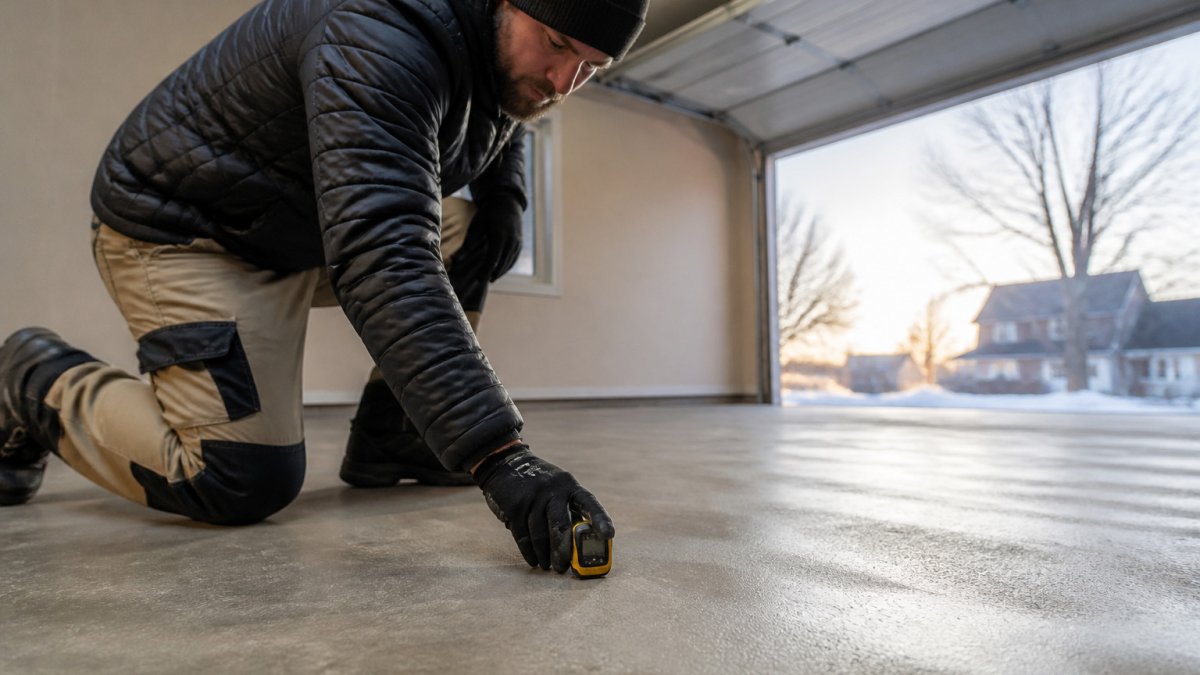
Common issues in cold-weather epoxy work include:
- Amine blush, a waxy residue that forms when humidity and low temperatures interact with the hardener
- Pinholes caused by air escaping from the concrete as it warms
- Slow or incomplete cure leaving a tacky surface
A common mistake is rushing to beat the weather. A coat applied outside the temperature window looks acceptable at first and then fails within a season. If your installer cannot control garage temperature for the full cure, consider a faster-curing system.
Garage Floor Coating Cure Time in Cold Weather
Cure time is the period between application and safe use, and it stretches in cold conditions, sometimes significantly.
As a broad guide, epoxy typically needs several days before light foot traffic and longer before vehicles return, depending on temperature and product. Polyaspartic systems generally return to use faster than epoxy.
For homeowners planning around a car or workshop, the practical question is how many days the space will be out of use. The full cure times explained guide breaks down the timeline for each system.
Road Salt Resistant Garage Floor Coating and Freeze-Thaw Exposure
Road salt is the single most damaging agent a cold-climate garage floor faces, and not all coatings resist it equally. Understanding how salt and freeze-thaw attack the floor lets you compare chemistries on evidence rather than marketing claims.
How salt damages a coated floor
De-icing salt, typically sodium chloride, sometimes calcium chloride or magnesium chloride, arrives as brine on tyres and as crystalline residue. Three mechanisms cause damage:
- Osmotic blistering: salt solution migrates through pinholes or microcracks in the coating and pools at the bond line. Water moves toward the higher salt concentration, swelling the pocket and lifting the coating.
- Crystallisation pressure: as water evaporates, salt crystals grow in pores and cracks, exerting pressure that can spall concrete and break the coating’s edge bond.
- Chemical attack: chloride solutions can degrade weaker resin systems over repeated exposure, softening the surface and reducing abrasion resistance.
Freeze-thaw compounds all three. Water trapped in the slab expands by roughly 9% when it freezes, flexing the concrete and stressing the coating bond. Repeated cycles, common in a garage that warms by day and freezes overnight, fatigue rigid coatings until they crack.
Comparing chemistries on salt and freeze-thaw
- Epoxy: good chemical resistance to many household substances, but rigid and prone to cracking under repeated freeze-thaw movement. Standard epoxy is the weakest choice for heavy salt exposure unless protected by a flexible topcoat.
- Polyaspartic: better flexibility than epoxy and good resistance to de-icing salts. Fast cure reduces the window for moisture contamination during installation. A strong all-round choice for salt-exposed garages.
- Polyurea: the most flexible of the common chemistries, with excellent resistance to salt brine and slab movement. Best suited to slabs that move or see heavy salting, though installation is more demanding.
A common pattern in cold-climate installations is a polyaspartic or polyurea base with a polyurethane topcoat, combining flexibility and salt resistance with UV stability.
Traction and slip resistance
Wet, icy or salt-wet coatings can be slippery. Ask for slip-resistance data (often quoted as a pendulum test value) or specify a broadcast aggregate finish for grip. This matters most on sloped driveways, near steps, and in garages used by children or older family members.
Winter maintenance that extends coating life
- Rinse, don’t scrub: a gentle rinse of meltwater and salt residue removes the chemical load without abrading the coating.
- Wipe salt residue promptly: crystalline salt left on the surface draws moisture and accelerates blistering at edges.
- Manage grit: sand and grit tracked in act as an abrasive. A mat at the door and regular sweeping reduce wear.
Repairing damage in cold conditions
Localised damage, a chipped edge, a small blister, a crack, can often be repaired without recoating the whole floor. The key constraint is temperature: repair kits have the same minimum temperature limits as the original coating. In cold weather, warm the repair area and the patch material to the product’s minimum, clean back to sound coating, and feather the edges.
Keep a small quantity of the original coating and aggregate for touch-ups. Matching a repair to an aged floor is easier when you have the original materials.
Preparing Your Garage Floor for a Winter Coating
Preparation determines how long any coating lasts, and winter adds extra steps. If you want the slab handled before coating, our cleaning and sealing service is one option to consider.
Next, check the concrete for cracks, spalling and moisture. A moisture test shows whether water is rising through the slab.
Mechanical preparation, typically grinding or shot blasting, opens the concrete’s surface so the coating can bond.
Finally, let the garage reach a stable temperature before installation.
Did you know? Good preparation is usually more important than the coating brand.
Booking Your Cold-Climate Garage Floor Coating
Choosing the right coating is the first step. The second is working with an installer who understands cold-weather limits and will tell you when conditions are not suitable.
For a quote and a clear cure-time schedule for your space, contact Garage Floor Coatings and ask for a cold-climate assessment. Pricing depends on the size of the garage, the condition of the slab and the system selected, so contact Garage Floor Coatings directly for a current quote.
Frequently Asked Questions
What is the best garage floor coating for cold climates?
For most cold-weather garages, polyaspartic and polyurea systems are the strongest choices. Both can generally be applied in lower temperatures than traditional epoxy and cure faster, which shortens the time the garage is out of use. Polyurea is frequently cited for winter conditions because it resists degradation from road salt. Epoxy remains a cost-effective option when the garage stays above its minimum application temperature during installation and curing, so the right choice depends on your local conditions and the product’s stated temperature limits.
Can you apply epoxy garage floor coating in cold weather?
Yes, but only when the concrete and air stay within the product’s stated temperature range during application and curing. Epoxy generally needs warmer conditions than polyaspartic or polyurea, and cold concrete can cause poor adhesion and slow curing. Check the manufacturer’s data sheet for minimum temperatures, measure the slab surface rather than relying on the air reading, and avoid installing on days when temperatures are expected to drop sharply overnight. Heating the space during cure and ventilating carefully helps the coating set properly.
How does road salt affect garage floor coatings?
Road salt and de-icing chemicals carried in on vehicle tyres can break down weaker coatings, particularly where moisture gets under the surface. Coatings with good chemical resistance and flexibility, such as polyurea, tend to hold up better against salt exposure and freeze-thaw cycles. Wipe up salty slush promptly, rinse the floor regularly, and reapply protective sealer when the surface starts to dull, as this extends the life of the coating through winter.
How long does garage floor coating take to cure in cold weather?
Cure time depends on the product and the temperature. Epoxy typically slows considerably in cold conditions and may need several days before it can take light foot traffic and vehicles, while polyaspartic and polyurea systems generally cure faster and can often be returned to service sooner. Always follow the cure schedule on the product data sheet and keep the space above the minimum temperature for the full curing period rather than assuming the surface is ready because it feels dry.
