Last Updated: October 29, 2026
Quick Summary
Acid etching vs grinding depends on the slab: acid etching suits bare, clean, unsealed concrete with light use, while grinding removes sealers, oil and contamination and gives a consistent, controllable profile for sealed, stained or vehicle-traffic garage floors.
- Acid etching dissolves only the cement paste and cannot reliably remove oil, grease, curing compounds or sealers.
- Grinding mechanically removes the top layer, giving a uniform, controllable surface profile across the whole slab.
- Test for sealers by pouring water: if it beads or sits on the surface, etching alone may not be enough.
- Measure slab moisture and temperature before coating, since both can cause failure regardless of preparation method.
- Grinding creates dust that requires proper containment and extraction, while etching adds water that must dry first.
Table of Contents
- Why Surface Preparation Decides How Long Epoxy Lasts
- How Acid Etching Works and Where It Falls Short
- How Grinding Concrete Before Epoxy Achieves a Mechanical Bond
- Epoxy Floor Surface Profile: Matching the Method to the Slab
- Benefits of Epoxy Floor Acid Etching vs Grinding Side by Side
- Assessing Your Garage Slab Before You Choose a Method
- Booking Your Concrete Assessment and Epoxy Quote
- Frequently Asked Questions
Why Surface Preparation Decides How Long Epoxy Lasts
Epoxy bonds to the concrete beneath it, not to the paint or sealer that might already sit on top. Compare the epoxy resin floor systems the business installs once the surface is prepared. Most early coating failures trace back to a single decision made before any resin is mixed: how the slab was prepared. Choosing between acid etching and grinding is that decision, and getting it right matters more than the brand of epoxy you select, because the choice of acid etching vs grinding sets the foundation for everything that follows.
Acid etching and grinding are the two methods most often compared for garage floors. Both aim to open the surface so the coating can grip. They do this in very different ways, and they suit very different slabs.
The sections below explain how each method works, where each one falls short, and how to match the method to your floor.
How Acid Etching Works and Where It Falls Short
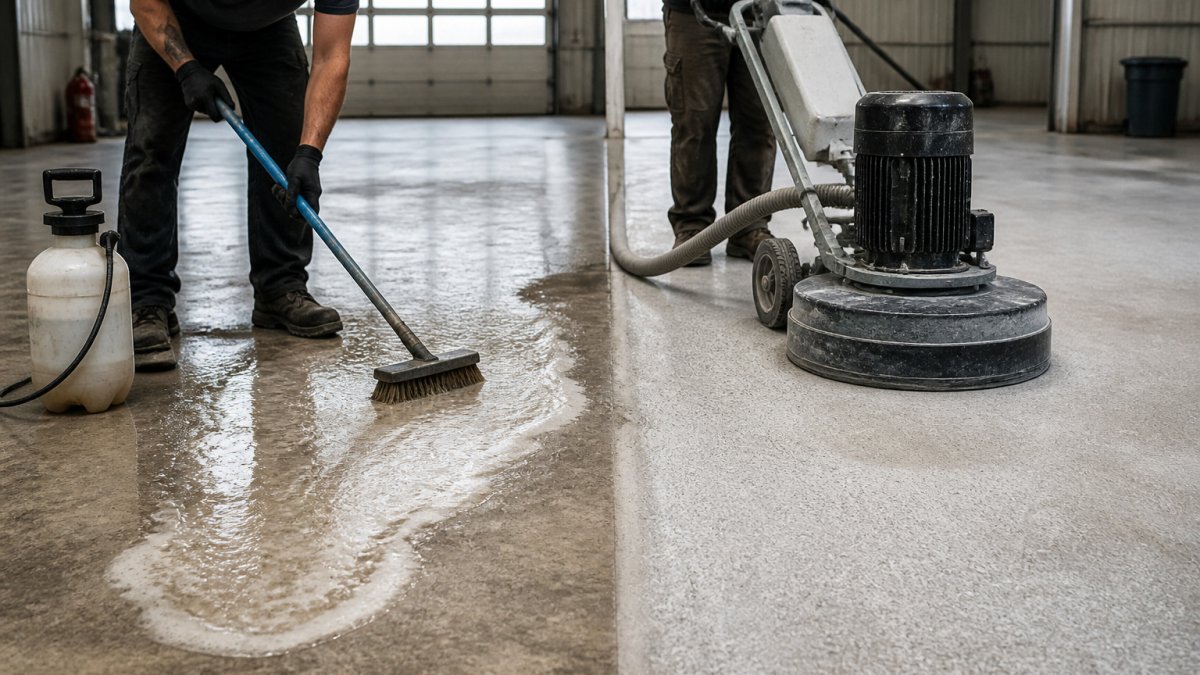
Acid etching applies a diluted acid, usually hydrochloric or muriatic acid, to the slab. The acid dissolves the thin, weak layer of cement paste on the surface and leaves a slightly rough texture.
The method is generally lower in upfront cost than grinding. It works best on bare concrete that has never been sealed, painted or heavily stained. In those conditions, the acid can open enough pores for a basic bond.
The limits are important. Acid cannot reliably remove oil, sealers, curing compounds or hardened contaminants. On a garage floor with years of oil drips, the acid may simply skip those areas, leaving smooth patches where the epoxy will not hold. Surface profile is also harder to control, so results vary from one section of the slab to the next.
When acid etching is a suitable choice
Acid etching is a reasonable option when the slab is bare, relatively clean and unsealed. It is also a sensible choice for small, low-traffic spaces where the coating will see light use. A common mistake is assuming “no visible coating” means “no contamination.” Oil and curing compounds are often invisible, so test a small area first. If water beads on the surface, the concrete is likely sealed or contaminated and etching alone may not be enough.
Contaminants that acid etching can leave behind
Several substances block adhesion after acid etching. Oil and grease from vehicles are the most common in garages. Curing compounds applied during construction can also survive etching. Residue from previous paint, sealers or adhesives may remain as well. Any of these can cause the epoxy to lift or bubble within months, even when the surface looks rough and ready.
How Grinding Concrete Before Epoxy Achieves a Mechanical Bond
Grinding uses diamond-tipped discs on a floor machine to remove a controlled thickness of the top layer of concrete. You can see the concrete grinding service offered for this kind of preparation. Unlike acid, the grinder physically cuts through contamination, sealers and laitance. The result is a uniform, open surface with consistent texture across the entire slab.
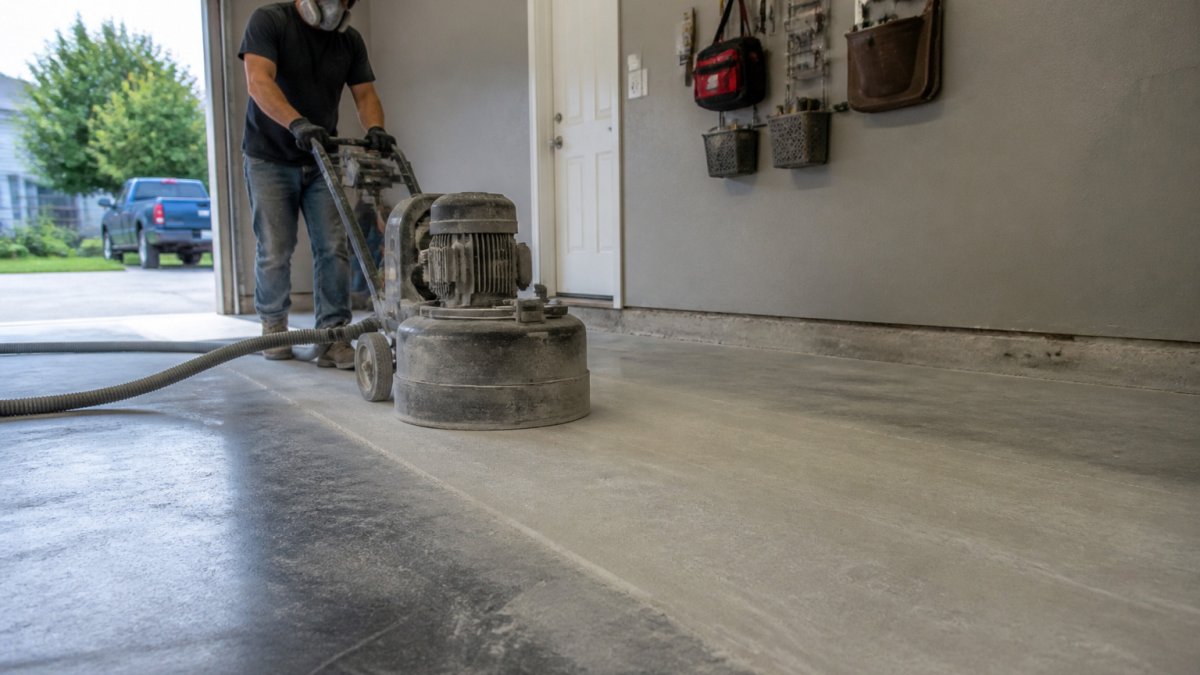
This consistency is the main advantage. The epoxy bonds mechanically into the profile the grinder creates, which gives it a stronger grip than most chemical preparation can achieve. Grinding can also reveal the condition of the slab, including cracks, spalling or deep staining.
Grinding does create dust, so containment and proper extraction are essential. It is also more labour-intensive and usually costs more than etching. For sealed, stained or heavily used garage floors, grinding is generally the more reliable route.
Epoxy Floor Surface Profile: Matching the Method to the Slab
Surface profile describes how rough the prepared concrete is, usually measured against standard profile grades. The right profile depends on the coating system and the expected traffic. Too smooth and the epoxy cannot grip. Too coarse and it wastes resin and can leave a textured finish that is hard to keep clean.
Acid etching produces a light, variable profile. Grinding produces a profile you can set and control. Etching is generally less suited to floors that carry vehicles, tools or heavy wheeled loads. If the profile is not right, no product can compensate for it.
When matching the method to the slab, ask three questions. Is the concrete sealed or contaminated? How heavy will the use be? Is the finish cosmetic or functional? A bare, clean, lightly used floor may suit etching. A sealed or stained garage with daily vehicle traffic almost always needs grinding.
Benefits of Epoxy Floor Acid Etching vs Grinding Side by Side
A fair comparison has to be made on criteria that actually predict whether the coating stays down. The table below sets out the trade-offs on the factors that matter most in a working garage, followed by the mechanisms behind each row.
| Factor | Acid etching | Diamond grinding |
|---|---|---|
| Typical cost | Lower upfront; DIY kits are widely sold | Higher upfront; charged per square metre and by access difficulty |
| Contaminant removal | Dissolves cement paste only; oil, grease, curing compounds and sealers survive | Mechanically removes the top layer, including sealers, laitance and surface contamination |
| Surface profile | Light and variable, typically equivalent to a shallow etched profile | Controllable; diamond tooling is selected to produce a specified profile grade |
| Suits sealed or stained slabs | Rarely | Yes |
| Exposes slab defects | Limited | Yes, cracks, spalling, aggregate and moisture-sensitive patches become visible |
| Moisture effect | Rinsing adds water to the slab and lengthens drying time | Dust extraction is dry; no added moisture |
| Dust and containment | Low dust, but acid mist and rinse water must be managed | Requires shroud and HEPA extraction; silica dust controls are essential |
| Temperature sensitivity | Acid strength and reaction rate change with temperature; rinsing in cold conditions slows drying | Grinding itself is less temperature-sensitive, but the slab still has to be within the coating’s application range |
| Best for | Bare, clean, unsealed slabs with light use | Sealed, contaminated or heavily used slabs, and any floor carrying vehicles |
Pros of acid etching: low material cost, simple equipment, quick to set up on a small bare slab, and no dust plume.
Cons of acid etching: unreliable on contaminated concrete, uneven profile, adds water that must dry before coating, and leaves no record of what was removed.
Pros of grinding: consistent and verifiable profile, removes contamination rather than working around it, reveals slab condition before you commit to a coating, and does not introduce water.
Cons of grinding: higher cost, more labour, requires dust extraction and edge tooling, and needs a competent operator to avoid gouging or polishing the surface.
Two rows deserve a closer look because they are where most failed jobs are decided.
Profile, not roughness. ‘Rough’ is not a specification. Grinding lets the operator choose diamond grit and passes to hit a target profile, and the profile can be checked with a surface-profile comparator or by a simple acid-test patch.
Moisture and temperature, not just cleanliness. Acid etching is a wet process. On a cool slab the rinse water sits longer, and coating over damp concrete traps moisture that later drives the epoxy off the surface.
Choose on the slab, not on the price list. A cheap etch on a sealed or oil-contaminated floor is the most expensive option available, because the failure shows up after the furniture is back in.
Quote your own project against this table, then confirm the two variables the table cannot see: the slab’s moisture condition and the temperature at the time of coating. Those two decide whether either method succeeds.
Assessing Your Garage Slab Before You Choose a Method
A method is only as good as the slab it is applied to.
1. Identify what is on the surface. Look for a sheen, a colour difference at the edges, or a chalky film. Sealers, curing compounds, paint and adhesive residue all block adhesion, and acid etching will not remove them reliably.
2. Check for oil and grease. Garage slabs collect drips that are invisible until you look at them in raking light. Oil contamination is the single most common reason an etched floor fails, because the acid cannot penetrate where oil has soaked in.
3. Measure moisture, not just dampness. Concrete gives off moisture vapour for years, and a coating applied over a slab that is still emitting will blister or debond regardless of how well it was profiled.
4. Record the temperature of the slab, the air and the product. These are three different numbers. A garage can feel warm while the slab stays cold, particularly in the cooler months or where the slab is in contact with ground that holds temperature.
5. Inspect for defects that need repair first. Cracks wider than a hairline, spalling, honeycombing and failed patches need repair before any coating goes down. Grinding exposes these; etching tends to hide them under a thin slurry of dissolved cement.
6. Match the method to the use. A bare, clean, lightly used floor may suit etching. A floor that carries vehicles daily, handles oil and chemicals, or has been sealed or painted in the past almost always needs grinding.
Do not skip the moisture and temperature checks because the surface looks dry and the day feels warm. These are the two variables most often missed in DIY preparation and the two most likely to cause a coating to fail within its first year.
If you are unsure about any of these checks, a professional assessment is cheaper than a failed coating.
Booking Your Concrete Assessment and Epoxy Quote
A professional inspection of the actual slab can help identify contamination, moisture and profile requirements that a home test may miss. Review the garage epoxy flooring options before booking.
For a quote, contact Garage Floor Coatings directly. Pricing depends on slab size, condition, chosen system and access, so current prices and quotes are best obtained from the company’s website or team.
Frequently Asked Questions
Is acid etching or grinding better before applying epoxy?
Neither method is better in every case. Grinding is generally the more reliable choice for sealed, contaminated or heavily stained concrete because it removes the surface layer and mechanically opens the pores. Acid etching can be a lower-cost option for bare, untreated concrete in reasonable condition, but it may not remove curing compounds, oil or existing coatings. Inspect the slab first, then choose the method that matches its condition rather than defaulting to the cheapest option.
Can you acid-etch a concrete floor before applying epoxy?
Yes, acid etching is used on some bare concrete before epoxy, particularly where the surface is clean and has no sealer. Etching opens the surface and removes laitance, the weak layer on top of freshly placed concrete. It should be followed by thorough rinsing and drying, and the slab should be tested for moisture before coating. If the floor has been sealed, painted or oil-stained, acid etching is usually not sufficient on its own and grinding is the better preparation.
Does acid etching remove oil or paint from concrete?
Acid etching does not reliably remove oil, paint, sealers or curing compounds. These contaminants can stay on the surface and interfere with epoxy adhesion, which is why some coating manufacturers no longer recommend acid etching as a primary prep method. Mechanical grinding or shot blasting removes these layers more effectively. If you are unsure whether a slab is contaminated, a simple water-droplet test and a moisture check can help you decide before any work starts.
How rough should concrete be before applying an epoxy coating?
Epoxy needs a surface profile that gives it mechanical grip, but the target depends on the product and the concrete’s condition. Surface profile is usually described on a scale of CSP 1 to CSP 9, and most garage and workshop coatings bond well at a light to medium profile. Over-grinding can expose aggregate and weaken the surface, while under-preparing leaves the coating vulnerable to peeling. Follow the coating manufacturer’s written specification and have the surface profile checked before coating.
