Last Updated: November 13, 2026
Quick Summary
Yellowed epoxy flooring needs replacing when the coating is lifting, soft, or unbonded, not simply when it has changed colour. Two or more widespread failure signs, such as peeling, bubbling, or uniform amber, point toward replacement, while cosmetic fading usually only needs a clean and UV-stable recoat.
- Peckham Coatings recommends a topcoat refresh at years 6 to 8, before base coats show wear.
- Press a coin into the surface; a permanent dent means the coating has broken down.
- Yellowing can show within 3 to 12 months of direct sun exposure on an unprotected floor.
- Epoxy floor lifespan sits at roughly 10 to 20 years for a professionally installed residential system.
- Coating warranties often cover adhesion failure but may exclude cosmetic yellowing and UV fade.
Table of Contents
- Why Yellowed Epoxy Flooring Is Not Automatically a Replacement Job
- Seven Signs Your Yellowed Epoxy Flooring Has Failed
- How to Fix Yellowed Epoxy Flooring Before You Rip It Out
- Epoxy Floor Coating Peeling and Bubbling: The Failure That Ends a Floor
- Epoxy Floor Lifespan: What You Should Realistically Expect
- How to Prevent Epoxy Floors from Yellowing Again
- When to Call a Professional for Yellowed Epoxy Flooring
- Book a Floor Assessment Before You Commit to Replacement
- Frequently Asked Questions
Why Yellowed Epoxy Flooring Is Not Automatically a Replacement Job
Yellowed epoxy flooring is a cosmetic problem in most cases, not a structural one.
Here is the part most guides get wrong: they treat any colour shift as a death sentence for the coating.
Peckham Coatings’ guidance on epoxy lifespan by environment recommends a topcoat refresh at years 6 to 8, before base coats show wear.
So how do you tell the difference between a floor that needs a facelift and one that needs replacing?
Seven Signs Your Yellowed Epoxy Flooring Has Failed
Yellowed epoxy flooring needs replacing when the coating is lifting, soft, or unbonded, not simply when it has changed colour. Run through these seven signs to find out which category your floor falls into.
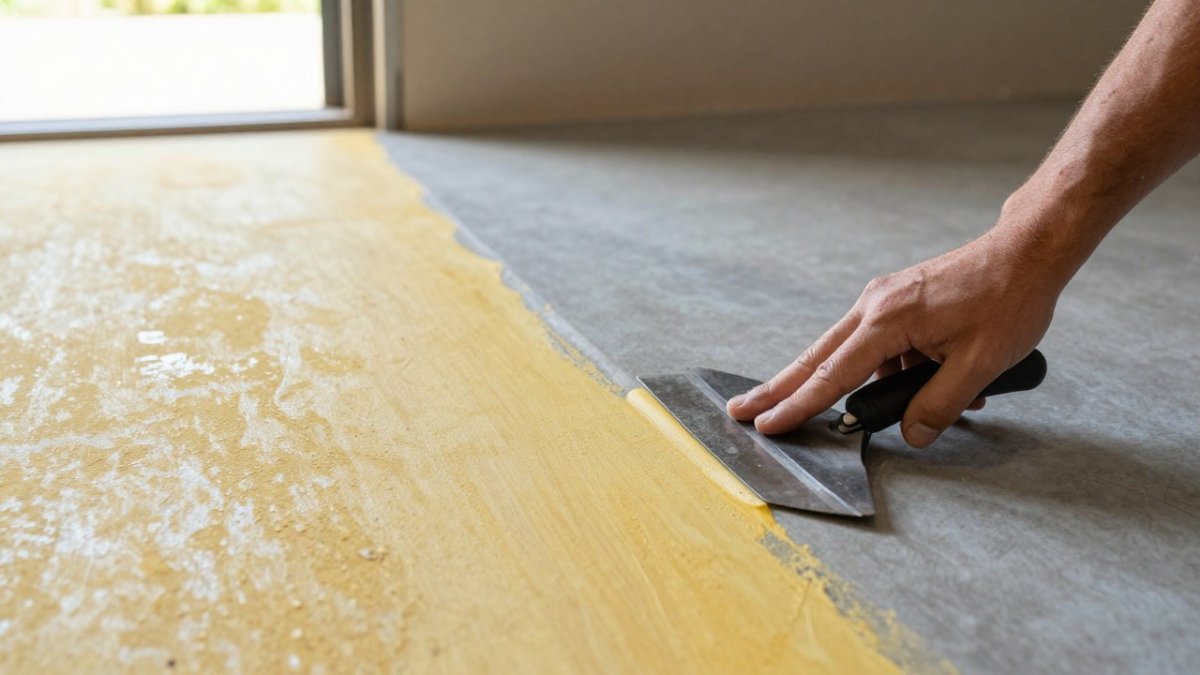
- Peeling or flaking at the edges. Coating that lifts away from the concrete has lost adhesion, and no topcoat will fix that.
- Soft or tacky patches. Press a coin into the surface. If it dents and stays dented, the coating has broken down.
- Bubbles or blisters. These usually signal moisture pushing up from the slab.
- Hot tyre pickup. Coating that softens and sticks to warm tyres is failing under heat.
- Widespread yellowing across the whole floor. Localised fading is cosmetic. Uniform amber across every square metre suggests deeper UV degradation.
- Cracks that follow the concrete. If the slab itself is moving, the coating cannot bridge it.
- A chalky, dusty surface. This means the resin has broken down at the top layer.
A Diagnostic Checklist for Assessing Coating Condition
Use this checklist before you commit to anything:
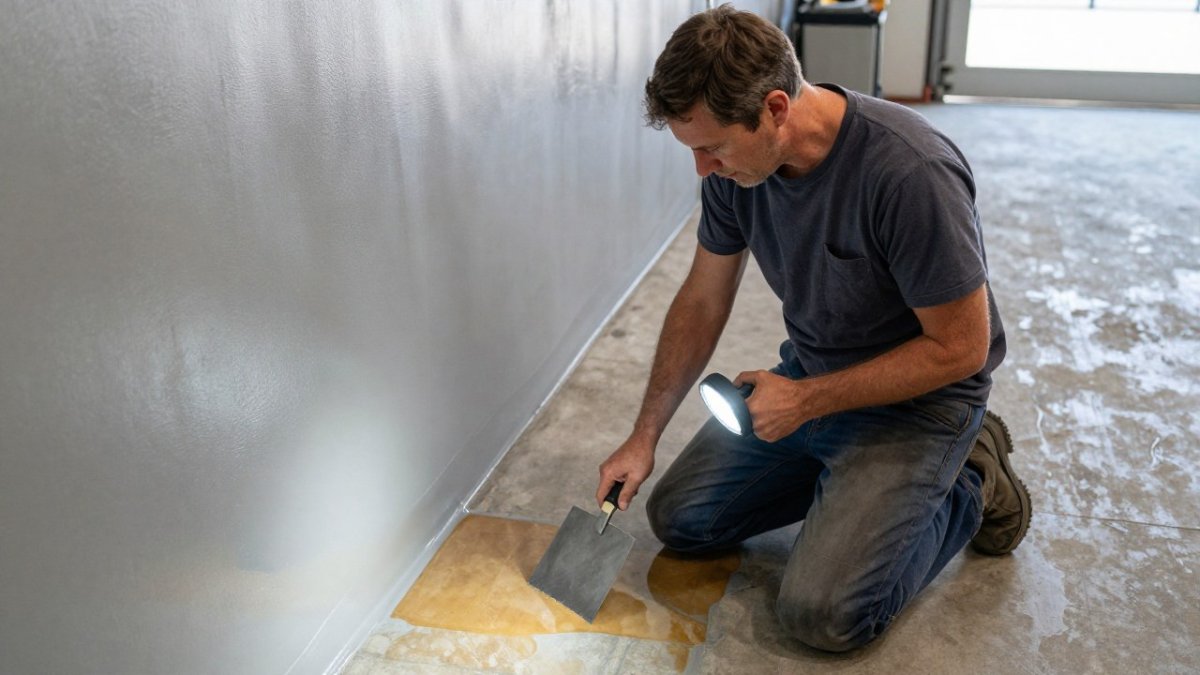
- Scrape a small edge with a putty knife. Does the coating come away in sheets?
- Press a coin into a warm patch. Does it leave a permanent dent?
- Check for bubbles, blisters, or lifting near doors and windows.
- Look for cracks that mirror the concrete beneath.
- Note whether yellowing is patchy or uniform.
Two or more ticks against the failure signs points toward replacement. One or none, and you are likely looking at a repair.
Here are the seven failure signs, what each one means, and how it points toward repair or replacement.
| Sign | What it means | Likely outcome |
|---|---|---|
| Peeling or flaking at edges | Coating has lost adhesion to concrete | Replacement |
| Soft or tacky patches | Coating has broken down | Replacement |
| Bubbles or blisters | Moisture pushing up from the slab | Replacement |
| Hot tyre pickup | Coating failing under heat | Replacement |
| Widespread uniform yellowing | Deeper UV degradation | Replacement |
| Cracks that follow the concrete | Slab is moving; coating cannot bridge it | Replacement |
| Chalky, dusty surface | Resin broken down at top layer | Replacement |
How to Fix Yellowed Epoxy Flooring Before You Rip It Out
Fixing yellowed epoxy flooring starts with cleaning, not coating. Dirt, grease, and oil sitting on the surface can read as discolouration when the resin itself is fine.
Simiron’s epoxy problem-solving guide recommends cleaning away dirt, grease, or oil and dulling the surface as the first repair steps for a yellow or amber hue.
Where the yellowing is genuine UV damage and the coating is still bonded, a screen-and-recoat is the usual fix.
Repair, Recoat or Replace: A Decision Framework
Most guides stop at ‘recoat if it’s only faded’. That leaves you guessing at the margins. Use this three-tier framework to place your floor before you spend anything.
Tier 1, Clean and recoat (cosmetic yellowing only). The coating is fully bonded, hard under a coin, and free of bubbles or lifting.
Tier 2, Spot repair then recoat (localised failure). One or two areas have lifted, blistered or gone tacky, but the rest of the floor passes the coin and scrape tests. You grind back the failed patches to sound concrete, prime and rebuild those areas, then recoat the whole floor for a uniform finish. Viable when the failed area is a small fraction of the total and the cause (a door threshold, a hot-tyre zone) can be corrected.
A common pattern is a floor that sits between tiers.
What Each Option Actually Costs
Costs vary with floor size, access and condition, and pricing depends on the scope of work.
If a recoat quote is close to the price of a replacement, ask what condition issues were found before comparing the two figures.
If you want a finish that resists yellowing from the start, it’s worth looking at polyaspartic flooring as a topcoat option.
Epoxy Floor Coating Peeling and Bubbling: The Failure That Ends a Floor
Epoxy floor coating peeling and bubbling is the point of no return.
Peeling usually traces back to moisture in the slab, poor surface preparation, or a coating applied too thin. Bubbling often means the same thing: damp concrete pushing vapour up through the film.
Coating over a bubbling floor without fixing the moisture source typically causes the new coat to lift within months.
When peeling or bubbling is widespread, mechanical removal and a fresh system is the honest answer. A proper epoxy resin floor build, with correct preparation and a moisture barrier where needed, is what stops the cycle repeating.
Epoxy Floor Lifespan: What You Should Realistically Expect
Epoxy floor lifespan sits at roughly 10 to 20 years for a professionally installed system in a residential setting, according to Apex Epoxy Perth’s durability guide.
Direct sun speeds this up. Jinyu Paint’s yellowing guide notes that yellowing can show within 3 to 12 months of direct sun exposure on an unprotected floor. That is fast, and it is why UV-stable topcoats matter.
Service Life Is Not One Number
The 10-to-20-year figure is an average across very different conditions. The same product can last twice as long in one space as another. Four factors move the number most:
- Installation quality. Correct slab preparation, moisture testing and coat thickness are the biggest single influence. A well-prepped system routinely outlasts a poorly prepped one by years, regardless of product brand.
- Product type. A standard clear epoxy topcoat yellows and chalks faster than an aliphatic polyurethane or polyaspartic topcoat. The base coat may be sound while the topcoat is spent, which is exactly the case where a recoat, not a replacement, is justified.
- Exposure. A north- or west-facing garage door, a patio, or a glass-walled workshop accelerates UV degradation. A fully enclosed interior floor may never yellow at all.
- Traffic and heat. Hot-tyre pickup and heavy point loads break down the surface faster than foot traffic alone.
Room by Room: Where Replacement Is More Often Justified
Different spaces fail in different ways, and that changes the replace-or-repair call:
- Garages. The most common yellowing complaint. UV through the door and hot-tyre contact do the damage. If the failure is confined to the door zone and tyre tracks, spot repair plus a UV-stable recoat is usually the right call. Widespread softening across the whole slab points to replacement.
- Patios and outdoor areas. Fully exposed to sun and weather. Standard epoxy is a poor long-term choice here, and a floor that has yellowed and chalked across the whole surface is usually better replaced with a UV-stable system than repeatedly recoated.
- Interior floors. Low UV, so yellowing is more often chemical (spills, cleaning products) or amine blush than sun damage. These usually clean up or recoat successfully.
- Wet areas and laundries. Moisture is the dominant risk. Bubbling or lifting here is a moisture problem first and a coating problem second, recoating without addressing the source is wasted money, and replacement with a moisture-tolerant system is often the honest answer.
Warranty and the Replacement Decision
Warranty terms are worth checking before you replace, because they tell you what the installer expected the system to do. Coating warranties often cover adhesion and coating failure for a defined period, but may exclude cosmetic yellowing and UV fade.
If downtime is your concern, our guide to garage flooring cure times breaks down exactly how long you’ll be off the floor.
How to Prevent Epoxy Floors from Yellowing Again
Preventing yellowing comes down to blocking UV and keeping the surface clean. A few habits go a long way:
- Fit blinds or a UV film on garage windows and glass doors.
- Choose a UV-stable topcoat, such as an aliphatic polyurethane, over standard clear epoxy.
- Wipe up oil and chemical spills promptly rather than letting them sit.
- Avoid parking a hot vehicle on the floor straight after a long drive.
- Recoat at the first sign of dulling, before the base coat is exposed.
A common mistake is skipping the topcoat to save money. The topcoat is the sacrificial layer. Let it take the UV hit, not the coloured base.
When to Call a Professional for Yellowed Epoxy Flooring
Call a professional when the failure signs stack up, when the slab has moisture issues, or when you want a warranty on the result. Grinding, moisture testing, and correct product selection are not weekend-kit territory.
Garage Floor Coatings has over 20 years of experience in epoxy resurfacing, using epoxy, polyurethane, and flake systems. If you’d rather hand the job off, you can see what a garage epoxy flooring install covers.
Book a Floor Assessment Before You Commit to Replacement
Before you spend on a full replacement, get the floor assessed. A proper assessment tells you whether you need a recoat, a repair, or a new system, and it saves you from paying for work you didn’t need.
Garage Floor Coatings offers a seamless experience from initial consultation to the final finish, with meticulous attention to detail. If you’re ready to move, get in touch with our team to arrange a floor assessment.
Replacing a floor you didn’t need to replace is an expensive mistake.
Frequently Asked Questions
Can yellowed epoxy flooring be restored without replacing it?
Often it can. When yellowing is the only problem and the coating is still bonded, a screen-and-recoat can restore the surface. A screen-and-recoat typically costs considerably less than a full replacement. The catch is that the new topcoat must be UV-stable, such as an aliphatic polyurethane, or the yellowing returns. If the floor is also peeling, soft or poorly bonded, recoating will not hold and full removal is the safer path.
How long does an epoxy floor coating last before it needs replacing?
Professionally installed epoxy flooring commonly lasts roughly 10 to 20 years in residential settings. A topcoat refresh is often considered around years six to eight, before the base coats show wear. Yellowing can appear much earlier than that, sometimes within 3 to 12 months of direct sun exposure, but early discolouration is cosmetic. Service life depends on UV exposure, traffic, moisture and how well the slab was prepared before the first coat went down.
Does sunlight cause epoxy floors to yellow?
Yes, and it is the most common cause. Standard epoxy uses aromatic resin, which reacts to UV light and turns amber over time. Yellowing can become noticeable within several months of direct sun exposure. Windows, open garage doors and skylights all let UV through. A UV-resistant topcoat such as aliphatic polyurethane slows this down, and keeping blinds or doors closed during peak sun reduces exposure further.
How can I tell if my yellowed epoxy floor is failing or just discoloured?
Look past the colour. Press a scraper or knife under an edge: if coating lifts easily, adhesion has gone. Check for soft or tacky patches, bubbling, blistering and white blotchy haze, which points to amine blush rather than UV yellowing. Also look for cracks, chalking and worn patches where the base concrete shows through. Discolouration alone is cosmetic. Lifting, softness, bubbling or bond failure means the coating has failed and replacement is usually the answer.
