Last Updated: November 16, 2026
Quick Summary
Aluminium oxide and silica sand are the most common slip-resistant epoxy floor additives for garages. Aluminium oxide gives the strongest wet grip but traps more dirt, while silica is the lower-cost option with a gentler texture. The best choice depends on how wet, oily or vehicle-heavy the garage is.
- Aluminium oxide gives high wet traction but needs more frequent sweeping and mopping.
- Silica sand is usually the lower-cost option and gives a medium, gentler texture.
- Polymer beads and fine glass media suit garages where a smoother feel and easy cleaning matter most.
- Add the grit before the coating skins over, and never change the resin-to-hardener ratio.
- Test a small patch first to check grip, texture and appearance before coating the whole floor.
Table of Contents
- Why Epoxy Garage Floors Become Slippery and When Additives Help
- Aluminium Oxide Anti-Slip Additive for Epoxy: Types and Trade-Offs
- Silica Grit for Epoxy Floors Compared Side by Side
- How to Make Epoxy Floors Non-Slip: Quantities, Mixing and Timing
- Choosing an Additive for Wet, Oily and Vehicle-Traffic Garages
- Cleaning Textured Epoxy Floors Without Losing Grip
- Choosing Your Anti-Slip Additive and Booking a Floor Assessment
- Frequently Asked Questions
Why Epoxy Garage Floors Become Slippery and When Additives Help
Slipperiness is one of the most common concerns with glossy coated concrete floors. A glossy epoxy finish looks sharp in a dry garage, but it can turn hazardous once it gets wet, oily or dusty. Smooth, glossy epoxy has very little surface texture, so water, oil and tyre residue sit on top of it instead of gripping the floor.
Anti-slip additives solve this by adding controlled texture to the coating. Mixed into the resin or broadcast onto the wet surface, these epoxy floor additives create tiny peaks that give boots, bare feet and tyres something to grip. The result is a floor that stays safe without sacrificing too much of its look.
Additives help most in garages where water is tracked in, where oil drips from vehicles, or where children and older family members walk on the floor regularly. They matter less in a dry, rarely used storage space, where a standard finish may be enough.
Aluminium Oxide Anti-Slip Additive for Epoxy: Types and Trade-Offs
Aluminium oxide is one of the most widely used anti-slip additives for epoxy. It is a hard, sharp-edged mineral grit, which means it produces a noticeable, consistent texture across the floor.
The trade-off is maintenance. A coarser aluminium oxide finish grips well but can trap dirt in its surface, so it needs more regular sweeping and mopping than a smooth floor. Finer grades reduce that problem while still offering useful grip.
Silica Grit for Epoxy Floors Compared Side by Side
Silica sand is the other common option, and it is usually the more budget-friendly choice. You can compare our epoxy resin floor service to see the coating these additives are applied to. It is also softer than aluminium oxide, so it tends to produce a gentler texture that feels less aggressive underfoot. But the choice between the two is rarely just about hardness, it comes down to how the floor will be used, how it will be cleaned, and what the coating system can carry.
Here is how the main additive materials compare in practice. Treat the ratings as relative, not absolute, because the grade you choose and the broadcast rate change the result.
| Material | Traction (wet) | Texture feel | Visibility in coating | Durability under tyres | Relative cost | Cleaning effort |
|---|---|---|---|---|---|---|
| Aluminium oxide | High | Coarse, sharp | Low, dark grit, blends into grey | High | Higher | Higher, traps dirt |
| Silica sand / grit | Moderate | Medium, rounded | Moderate, pale, can lighten dark coatings | Moderate | Lower | Moderate |
| Polymer / plastic beads | Moderate to high | Fine, rounded | Low to moderate | Moderate, can crush under heavy loads | Moderate | Lower, smooth surface |
| Glass bead / fine media | Low to moderate | Very fine, smooth | Moderate, can sparkle | Low to moderate | Moderate | Lowest |
| Rubber crumb | Moderate | Soft, cushioning | High, coloured | Low, degrades with UV and traffic | Moderate | Moderate |
A few practical notes on that table:
- Traction in wet conditions: Aluminium oxide holds grip best when water or oil sits on the surface because its angular particles cut through the film. Silica provides useful grip but rounds off faster under scrubbing and tyre traffic.
- Texture and bare feet: Polymer beads and fine glass media feel much smoother underfoot, which matters in a garage that doubles as a play area or is used barefoot. Aluminium oxide is noticeably abrasive.
- Visibility and appearance: Pale silica can lighten a dark coating and show as a speckle. Dark aluminium oxide disappears into grey or charcoal floors. Coloured rubber crumb changes the look entirely, so test a patch before committing.
- Durability under vehicle traffic: Tyres scrub and roll the surface. Harder minerals resist that wear longer; softer media can polish or crush over time, reducing grip where wheels track.
- Cleaning effort: The coarser the texture, the more dirt it traps. Aggressive aluminium oxide needs more frequent sweeping and mopping than a fine polymer or glass finish.
- Cost: Silica is often the lower-cost option, though prices vary with quantity, grade and supplier. Aluminium oxide costs more per unit but may need less material to reach the same grip.
Silica suits a family garage where the main concern is preventing slips from the occasional wet shoe and the floor is cleaned regularly. Aluminium oxide suits a workshop where oil, tyres and heavier movement make grip the priority. Polymer beads and fine media suit garages where a smoother feel and easier cleaning matter more than maximum traction.
A short test patch in a corner of the garage will tell you more about texture and appearance than any specification sheet.
How to Make Epoxy Floors Non-Slip: Quantities, Mixing and Timing
Getting the epoxy floor additives right depends on mixing and timing as much as on the product you choose. A common mistake is adding the grit too late, after the coating has begun to skin over, which leaves the texture sitting only on the surface and wearing away quickly.
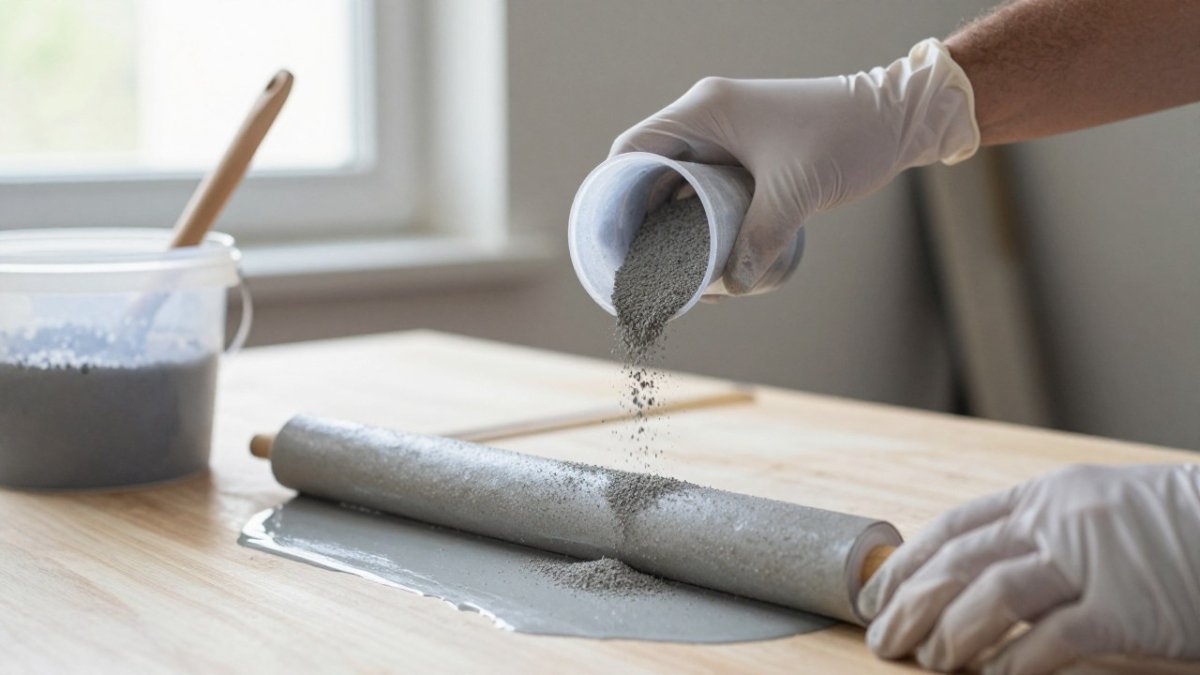
There are two main ways to introduce the additive, and they behave differently:
- Mixed in (also called seeded or stirred in): The additive is stirred into the mixed resin before application. This gives a uniform texture through the coating and is common for aluminium oxide and silica. It thickens the mix, so work in small batches and keep to the pot life.
- Broadcast (also called scattered or sprinkled): The additive is scattered onto the wet coating after it has been laid, then often sealed with a clear topcoat. This concentrates grip at the surface and lets you control density by eye. It uses more material and needs a topcoat to lock the grit in.
Follow these general steps:
- Mix the resin and hardener exactly as the manufacturer’s instructions specify. Do not change the ratio. Additives do not replace hardener, and adding extra grit does not speed curing.
- Add the anti-slip additive to the mixed resin, or broadcast it onto the wet coat, depending on the system you are using. If mixing in, add the grit slowly while stirring to avoid lumps. If broadcasting, work in sections so the coating does not skin over before you scatter.
- Work quickly. Epoxy has a limited working time, so have all materials ready before you begin. Mix only what you can lay within the pot life stated on the product data sheet.
- Allow full curing before the floor takes foot or vehicle traffic. Light foot traffic and full vehicle use usually come after different intervals, so check the product data sheet.
- Apply a topcoat if the system calls for one, to seal the additive and protect the surface. Not every additive is compatible with every topcoat, check the manufacturer’s guidance before sealing.
On quantities, there is no universal figure because coverage depends on the product, the grade of grit and whether you are mixing in or broadcasting. Most suppliers state a coverage rate per square metre on the label or data sheet, and that figure should be your starting point. As a general pattern, broadcast rates are higher than mix-in rates because some material is lost or left loose and swept away.
Compatibility matters as much as quantity. Compatibility varies by system, so check the product data sheet before mixing. If you are applying a clear topcoat over decorative flakes, a coarse grit can dull the flake appearance, so a finer media may suit better. Where the data sheet is unclear, follow the manufacturer’s instructions or consult a coating professional before mixing products from different brands.
Watch out: skipping the test patch is a frequent error. Apply a small area first, let it cure and check the grip, texture and appearance before committing the whole floor. It is far easier to adjust the grade or quantity on a one-metre patch than on a finished garage.
Choosing an Additive for Wet, Oily and Vehicle-Traffic Garages
The right additive depends on what your garage sees. For a damp garage with occasional spills, a fine-to-medium grit usually provides enough traction without a heavy texture. You can see which garage epoxy flooring option suits wet, oily and vehicle-traffic garages. For a workshop where oil, brake fluid and cleaning chemicals are common, prioritise a finish that resists those substances and pair it with a grit that holds its grip when the surface is slick.
Vehicle traffic adds another factor. Tyres scrub the surface, so a finish that wears well under rolling loads will hold its grip for longer. Ask how the system performs under vehicle use, not just foot traffic.
Cleaning Textured Epoxy Floors Without Losing Grip
Textured floors need a different cleaning routine from smooth ones. Sweep or vacuum regularly to remove grit that can build up in the texture, then mop with a pH-neutral cleaner. Find out more about our cleaning and sealing service for textured floors. Harsh, abrasive or strongly alkaline cleaners can dull the coating and gradually reduce grip.
Avoid letting oil sit on the surface. Wipe up spills promptly, because residue trapped in the texture is harder to remove and can make the floor slippery even when it is dry. Rinse thoroughly so that cleaning product does not leave a film behind.
Periodic sealing can help protect the texture and keep the floor easier to maintain. Follow the coating manufacturer’s advice on which sealers are compatible, since some topcoats can change the surface feel.
Choosing Your Anti-Slip Additive and Booking a Floor Assessment
Every garage is different, so the best additive is the one that fits your moisture levels, traffic, cleaning habits and budget. Start by deciding how much grip you need, then choose between a harder aluminium oxide finish and a gentler silica option, and confirm the mixing and curing requirements before you commit.
If you are unsure which route suits your garage, contact Garage Floor Coatings for a quote and current pricing on our website. You can also book a floor assessment to choose the right additive for your space.
Frequently Asked Questions
What is the best additive to make an epoxy garage floor less slippery?
For most home garages, aluminium oxide is the most commonly recommended anti-slip additive because it gives a consistent, sharp texture that holds up to foot and vehicle traffic. Silica sand is a lower-cost option that works well for lighter use but can feel less uniform. The right choice depends on how wet the floor gets, whether oil or chemicals are spilled, and how much texture you can comfortably clean. Ask your coating provider to test a sample patch before committing to one additive across the whole floor.
Can you add anti-slip grit to garage floor epoxy?
Yes. Anti-slip grit is usually broadcast or mixed into the epoxy while it is still wet, before the final topcoat cures. Adding it to the base coat alone may leave the surface still slippery once the topcoat is applied, so many installers add it to the final coat where it is exposed. The grit must be fully embedded and evenly distributed, and any loose particles should be removed once the coating has cured.
Should anti-slip additive go in the epoxy coat or the topcoat?
The additive should usually go into the topcoat, because that is the layer your feet and tyres meet. Mixing it only into the base coat can leave the surface smooth once the topcoat seals over it. Some systems use a clear topcoat with grit broadcast onto it, while others mix the additive directly into the coloured finish. Confirm the method with your installer, as the coating system determines which approach gives reliable grip.
Does anti-slip grit make an epoxy floor harder to clean?
Textured surfaces can trap dirt and make mopping take longer than on a smooth floor. Finer additives create a gentler texture that is easier to clean, while coarser grit improves grip but holds more grime. A soft-bristled brush, a pH-neutral cleaner and regular sweeping usually keep a textured garage floor manageable. Choosing a fine-grade additive is often the best compromise for garages that need both grip and easy maintenance.
